Luciano Fabro
One of the founders of Arte Povera, Luciano Fabro expressed himself through a wide variety of materials and forms. In addition to creating art, Fabro also taught and wrote numerous texts that document his engagement in cultural debate.
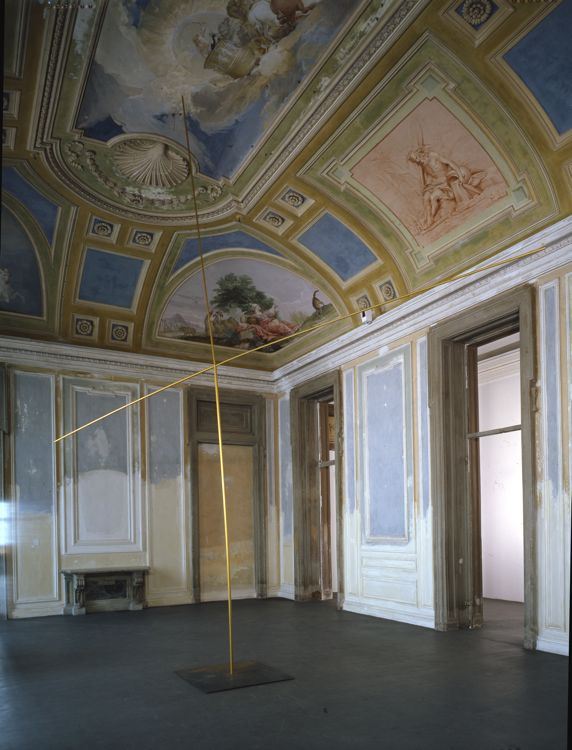
Beginning with his earliest work, the artist was interested in exploring the vocabulary of sculpture, using traditional materials, such as marble and iron, or innovative ones, such as glass and silk, intentionally liberating them from ties to representation or content. Croce (Cross), 1965–86, is part of an investigation that attempts to explore the possibilities of space and the bodies contained within it. The work is constructed so that the length of the metal segments is proportional to the dimensions of the surrounding space, and so that the work can be installed in such a way that it occupies the maximum available space.
In his own words, Fabro was interested in showing us “the encumbrance of the object in the vanity of ideology.” To achieve this, he adopted familiar, largely recognizable forms, while removing their collective symbolic function. In 1968 the artist began using the geographical outline of Italy, an immediately familiar image, turning it into a point of reference that he interpreted in various materials, including lead, crystal, paper, iron and even fur. “The shape of Italy,” Fabro said, “is static, immobile; I measure the mobility of my hands against a motionless thing. Italy is like an album of sketches, memoranda, which I continue to make through the years: if I study something new, I sketch it into an Italy.” In Speculum Italiae (Italy’s Mirror), 1971, the outlined shape of the country, lying on one side and placed against the wall, is rendered as a surface of mirrored glass, partly covered by flexible strips of lead.
In Italia all’asta (Italy on Auction), 1994, the shape of the map of Italy is made of iron and the reproductions superimposed on one another so that geographic coordinates are overturned. Run through by a long pole, the resulting sculptural form gives rise to multiple symbolisms: a flag, captured and skewered prey, or even a commodity, put up for public sale.
Attaccapanni (di Napoli) (Clothes Rack—of Naples), 1976–77, stems from an imaginary Neapolitan sunset and the colors related to it. The true subject of the work is light, understood as a play of colored shadings. The work is made up of five parts mounted on the wall, each formed by a painted cloth hung on a bronze structure. Made using the lost-wax process, the bronze elements feature different more-or-less invented shapes: leaves, pieces of bark, branches, rope and, as the artist has noted, “two squashed sex organs.” The sinuous lines of each bronze support determine the draping according to which the cloth is arranged, which appears as a surprisingly plastic element in view of the apparent lightness of the supports. Each of the pieces on the wall is subtitled with a line composed by the artist in Neapolitan dialect (’ncoppa ’a filologia ‘nu schiuppo ’e rrose ’ncarnate; Tengo int’ ’e palme mieie ’e gravune ardiente d’ ’o tramonte fino a che ’o vrasiere nun è priparato; Cu ‘a manica toia, cumpare, aggio culurate ’e verde ‘sta sera; Laureato ’e ceraso jetto ’a penna int’a ll’orizzonte; A ‘a corda d’o bucato mo s’è stesa pure ’a notte.)
Paolo Uccello 1450–1989, 1989, evokes the name of the Renaissance painter whose work is ruled by perspective, the mathematical precision of which is sometimes contradicted by his vivid imagination. This is the case of the frescoes in the Green Cloister of Santa Maria Novella in Florence, in which the biblical theme of the Flood is developed through anomalous and almost irrational perspectival constructions. While 1450, the first date in Fabro’s piece. refers to these frescoes, the second date in the work’s title is that of Fabro’s own solo exhibition at the Castello di Rivoli. Installed outdoors, the work inscribes a virtual cube in space, formed by two square metal frames suspended from steel cables. Each frame contains two segments of iron rod, one held vertically at the center of the square, the other attached by rings that run along the fixed element. The mobile rods are arranged in the space free from fixed connections, in fluctuating positions. Like a perspectival box, the work contains mobile elements and fixed ones, the latter referring to Euclidean space. In Fabro’s work, the association with Uccello calls up the transgression of the laws of perspective and offers instead a proliferation of different foreshortened views, depending on the viewpoint. As the artist has noted of the juxtaposition of the two dates in the title: perspective “is created case by case.”
[MB]