The Public Collection Interpreted and Expanded
New Commissions, Acquisitions, and Collection Reinstallations Reshape the Museum
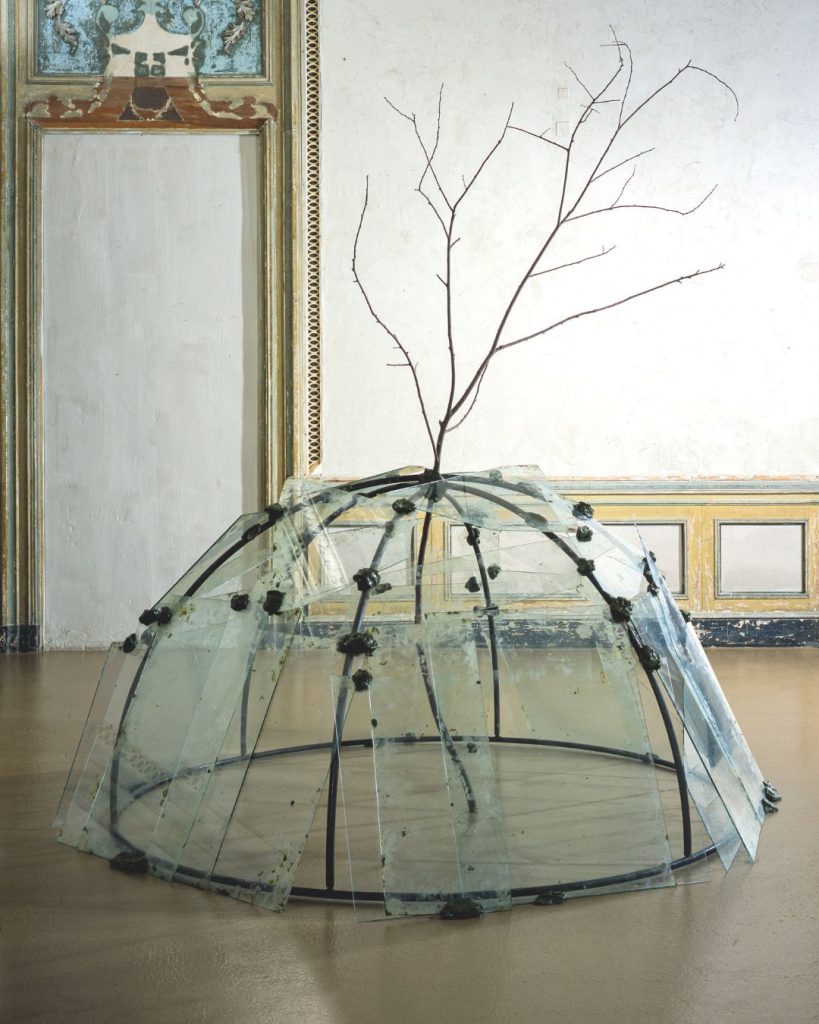
Mario Merz, Igloo con albero (Igloo with Tree), 1968-69
Courtesy Castello di Rivoli Museo d’Arte Contemporanea, Rivoli-Torino
Photo Paolo Pellion
Castello di Rivoli’s autumn season unfolds around a series of complementary initiatives that mark a new chapter in the Museum’s exhibition programme: the third edition of Inserzioni, the commissioning programme conceived by Francesco Manacorda; a new reinstallation of the Collection dedicated to Arte Povera; a gallery devoted to Giulio Paolini in memory of the collector Gino Viliani; a new edition of Il Castello Incantato, featuring a gallery paying tribute to Remo Salvadori; and the presentation of the works selected for the 2026 Piero Siena Prize. Although distinct in form, these projects share a common vision: that of a museum in which the Collection is not an endpoint, but a space of ongoing research and continuous transformation.
Francesca Lavazza, Chair, said:“Building a public collection today means far more than safeguarding cultural heritage. It means keeping it alive, continually renewing the ways it is interpreted and presented, and connecting it to the questions of our time through new commissions, collection reinstallations, and acquisitions. It also means enabling a collection to come into being, acting as a guarantor between artist and institution, taking responsibility for a public asset, and at the same time continuing to chart new paths.”
Francesco Manacorda, Director, said: “Commissioning new works and preserving cultural heritage are two expressions of the same public responsibility, not two separate activities. On the one hand, the Museum produces the present; on the other, it safeguards memory so that it can continue to generate the future.”
INSERZIONI | The Museum as a Place of Production
First and Second Floors, Castello Building
From 25 September 2026
Now in its third edition, Inserzioni is a permanent laboratory for the Museum. Conceived to engage contemporary artists with the Castle’s unfinished architecture and the Collection’s displays, the project periodically transforms the Museum’s permanent Collection galleries into a constantly evolving exhibition.
The new commissions by Haris Epaminonda, Christelle Oyiri, and Sung Tieu address some of the most pressing issues of our time: the migration of people and cultural forms, the relationship between architecture and the construction of identity, memory as a key to navigate the present, and the invisible structures that shape globalised society. Although working through profoundly different artistic languages, the three artists all investigate space as a cultural and political device. The home, the museum, and architecture become places where belonging, hierarchies, memories, and forms of power are embedded.
For Haris Epaminonda, the Castle becomes a portal that brings Juvarra’s grandly decorated room into dialogue with Casa Mollino, revealing unexpected correspondences between two radically different ways of constructing space as a representation of identity and, through fragmentation, opening it to multiple readings and narratives.
Sung Tieu’s new commission, a site-specific installation for Castello di Rivoli, investigates the forces that shape collective memory and belonging. Through an architectural intervention, the work considers how histories are embedded in spaces, structures, and lived experience.
Using the Memphis Pyramid as both protagonist and monument, Christelle Oyiri traces the afterlife of symbols across film, sculpture, and installation. Her work follows the transformation of sacred architectures into commercial spectacle, asking how belief survives historical rupture by continually mutating through music, popular culture, and Black diasporic imaginaries.
ARTE POVERA | Preservation Means Continuing to Activate
First and second floors, Castello Building
From July 2026
Alongside the new commissions, the Museum presents a major reinstallation of works from its Arte Povera collection. The historical nucleus of Arte Povera represents one of the founding identities of Castello di Rivoli. Not only because the Museum preserves one of the most important collections dedicated to the movement’s pioneers, but also because the international significance of this movement played a decisive role in driving the establishment of the Museum, which opened in 1984. The new presentation assigns each artist an autonomous space, highlighting masterpieces from the Collection, including works on permanent loan from Fondazione Arte CRT. Alongside works by Alighiero Boetti, Piero Gilardi, and Michelangelo Pistoletto, all located on the first floor, the new displays on the second floor present works by Giovanni Anselmo, Pier Paolo Calzolari, Jannis Kounellis, Mario Merz, Giuseppe Penone, and Gilberto Zorio, as well as a gallery dedicated to Emilio Prini (from October 2026), creating a true exhibition of the artistic group.
The reinstallation reaffirms the Museum’s role as a custodian of the preservation, study, and full accessibility of a public heritage that continues to speak to the present. As part of the new presentations highlighting Turin’s role as a creative hub, from October 2026, for the first time at Castello di Rivoli, a gallery will also be dedicated to Carol Rama, one of the greatest artists of the twentieth century.
GIULIO PAOLINI: IN TWO ACTS
In memory of Gino Viliani
Curated by Marcella Beccaria and Andrea Viliani
Second floor, Castello Building, Gallery 22
Act I: from July 2026
Act II: from October 2026
As part of the Collection reinstallations, Castello di Rivoli dedicates a gallery to Giulio Paolini, conceived in two acts. For the first act of the project, already underway since the summer, the artist has selected Contemplator enim and In esilio, pre-existing installations that become devices for the display of other works by the artist. In the second act of the project, from October 2026, these installations will host a group of works that belonged to Gino Viliani, a passionate collector of Paolini’s oeuvre, and have been pledged as a donation to the Museum. “Paolini thus transforms the gallery,” state the curators Beccaria and Viliani, “into an exhibition and narrative mechanism in which to bring together, as if on a single stage, different places, people, and roles: the artist’s studio, the domestic interior, the museum gallery, as well as the author, the collector, the curator, and the public.”
IL CASTELLO INCANTATO | The Museum as a Pedagogical Space
With curatorial collaboration by Marcella Beccaria, Francesco Manacorda, and Paola Zanini
Third floor, Castello Building
From September 2026
Il Castello Incantato is not only a display project but also an educational one, conceived and developed with non-adults who are involved in the process of engaging with contemporary art. Younger generations are conceived as the ideal visitors of the museum of today and of the future. Il Castello Incantato draws inspiration from the concept of the agorà, the main public square in the cities of ancient Greece, promoting the idea of the museum as a place of encounter and exchange, a pedagogical, experiential, and inclusive training ground, and a school of citizenship.
For the new 2026 edition, Il Castello Incantato presents an exhibition itinerary centred on important artists whose works have made a fundamental contribution to the history of the Collection and of the exhibitions at Castello di Rivoli. The project features works by John Baldessari, William Kentridge, Otobong Nkanga, and Paola Pivi. Special guests of the 2026 edition are Peter Friedl with No prey, no pay, a large-scale installation inspired by pirates and their forgotten stories, and Rivane Neuenschwander with dream.lab. Neuenschwander’s project draws inspiration from the creatures and monsters that inhabit children’s dreams. This new version of the work produced by the Museum also takes inspiration from drawings done by children from the region around the museum. They participated in workshops and activities organised by the Education Department following the artist’s instructions.
CONTINUO INFINITO PRESENTE | Homage to Remo Salvadori
In collaboration with the Remo Salvadori Archive
Third floor, Castello Building, Gallery 35
Within the context of Il Castello Incantato, a gallery is dedicated to Remo Salvadori, who sadly passed away during the preparation of the project. “In his search for the spiritual dimension within the real,” declares Marcella Beccaria, “Salvadori traced a path of rare ethical depth and coherence. Already initiated in close dialogue with Remo and subsequently developed in collaboration with his Archive, thanks to Sally Benjamin Salvadori, this gallery is a tribute to a great artist whose vision will continue to shine.” The new presentation includes La stanza delle tazze, 1985–86, an important work on colour and form inspired by the anthroposophical principles of Rudolf Steiner. Alongside this work, which belongs to the Castello di Rivoli Collection and holds great significance within the artist’s practice, the display presents works on loan from the Salvadori Archive.
Piero Siena Prize 2026 — Stefano Bernardi and Samira Mosca
Curated by Federica Lamedica
First floor, Castello Building, Galleries 15 and 16
From 25 September 2026
In collaboration with the Autonomous Province of Bolzano – South Tyrol, Italian Culture Department, and Museion – Museum of Modern and Contemporary Art Bolzano, Castello di Rivoli is participating in the 2026 edition of the Piero Siena Prize, as part of an agreement through which the Province acquires and donates works by artists working in South Tyrol to the partner museums, following a selection process conducted together with the museums themselves. The winning artists are Stefano Bernardi (Bolzano, 1970) for Castello di Rivoli and Samira Mosca (Bolzano, 1995) for Museion. Following an initial public presentation at the Trevi Centre in Bolzano in summer 2026, the prize-winning works are exhibited in the historic galleries of Castello di Rivoli, whose permanent collection acquires Bernardi’s work.