CONTINUO INFINITO PRESENTE | Omaggio a Remo Salvadori
Remo Salvadori
La stanza delle tazze (The Room of the Cups), 1985-1986
Pigments and wax on canvas on copper
Castello di Rivoli Museo d’Arte Contemporanea, Rivoli-Torino
Gift Fondazione Marco Rivetti
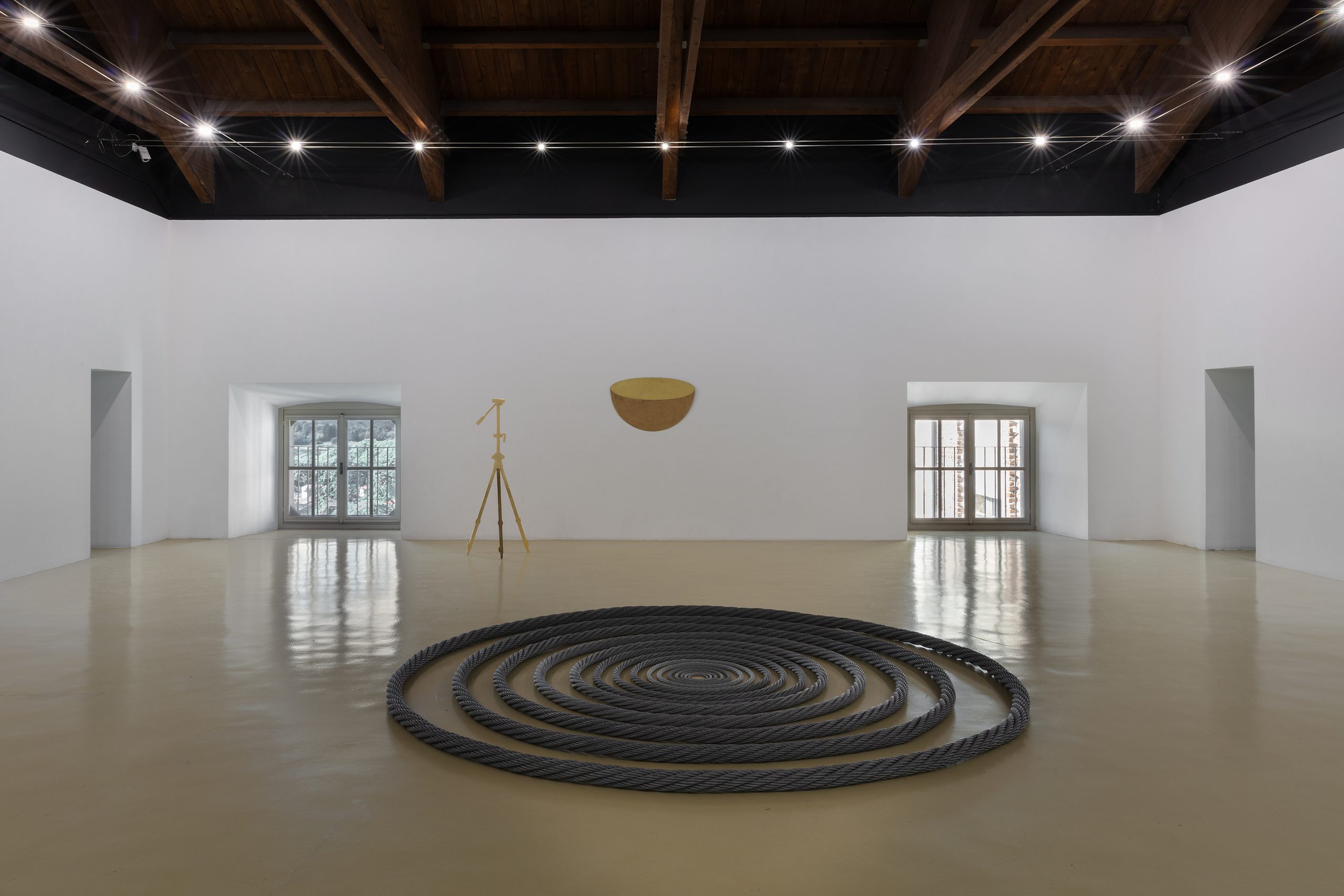
L’osservatore non l’oggetto osservato (The observer not the object observed), 1981-2017
Gilded iron
Courtesy Archivio Remo Salvadori
Continuo infinito presente (Continuous infinite present), 1985-2007
Steel cables, 16 elements
Courtesy Archivio Remo Salvadori and Galleria Christian Stein, Milano
Installation view at Castello di Rivoli in the frame of The Enchanted Castle
Courtesy Castello di Rivoli Museo d’Arte Contemporanea, Rivoli-Torino
Photo Sebastiano Pellion di Persano
In collaboration with Archivio Remo Salvadori
Third Floor, Castello Building, Room 35
Within the context of Il Castello Incantato, a gallery is dedicated to Remo Salvadori, who recently passed away during the preparation of the project. “In his search for the spiritual dimension in reality,” says Marcella Beccaria, “Remo Salvadori traced a path of rare ethical depth and coherence. Already initiated in close dialogue with the artist and subsequently developed in collaboration with his Archive together with Sally Benjamin Salvadori, this gallery is a tribute to a great protagonist whose vision will continue to shine.” The new installation includes La stanza delle tazze, 1985–86, an important work on colour and forms inspired by Rudolf Steiner’s anthroposophical principles. Alongside this work, which belongs to the Castello’s Collection and is of great significance in the artist’s oeuvre, two other important works by Salvadori are presented: Continuo infinito presente, 1985–2007, a series of concentric circles, each generated by the uninterrupted twisting of intertwined metal wires, and L’osservatore non l’oggetto osservato, 1981–2017. The latter belongs to a type of work that Salvadori also personally installed on the occasion of Ouverture II Sul museo, the second major exhibition organized during the early years of Castello di Rivoli Museo d’Arte Contemporanea