Enrico David – Domani torno
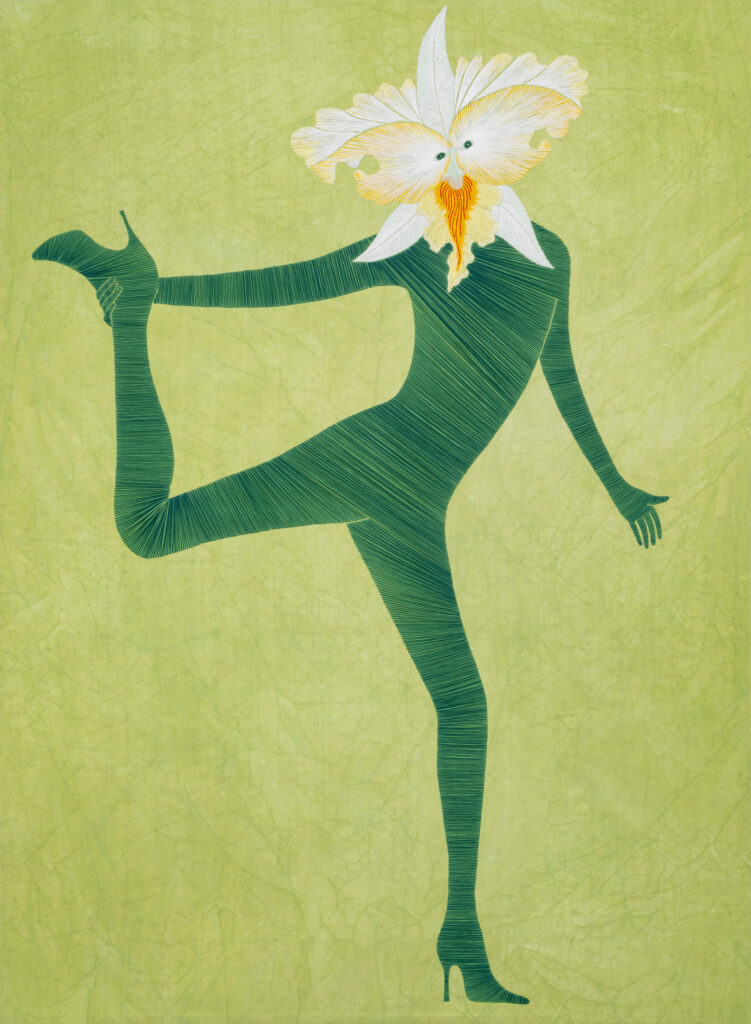
Enrico David, Dinnisblumen, 1999
wool on dyed canvas
300 x 200 cm
Raf Simons Collection, Antwerp
© Enrico David
Courtesy Michael Werner Gallery
Exhibition curated by Marianna Vecellio
30 October 2025 – 22 March 2026
Manica Lunga, Third Floor
Domani torno (I Am Back Tomorrow) is the largest solo exhibition ever dedicated to Enrico David (Ancona, 1966) and his most significant show in Italy. Although David has lived and worked abroad for nearly four decades and his artistic practice has been more widely exhibited internationally than in his native country, his career has included participation in three editions of the Venice Biennale. Curated by Marianna Vecellio, the exhibition brings together over eighty works, grouped into six thematic sections that reflect key moments in his creative evolution, reimagined here through a newly conceived installation.
Spanning over thirty years of artistic production, this expansive retrospective presents a non-linear narrative that weaves together past and present, experimentation and monumental installations, diverse materials and expressive languages. The exhibition invites visitors on an intense, at times frenzied journey through landscapes shaped by the grotesque and the carnivalesque, autobiography, theatre, and folklore.
The exhibition design, conceived by the artist, revolves around four seminal works: Madreperlage, David’s first large-scale installation, created for his 2003 solo show at Cabinet gallery in London; Ultra Paste, presented at the Institute of Contemporary Arts, London in 2007; Absuction Cardigan, shortlisted for the 2009 Turner Prize and exhibited at Tate Britain; and Tutto il resto spegnere (All else shut down), part of the body of work shown in the Italian Pavilion at the 58th Venice Biennale in 2019. These works stand as symbolic cornerstones, foundational elements in the construction of a metaphorical dwelling reached at the end of an idealised homecoming (in Greek nostos, the word at the origin of nostalgia).
The exhibition
The exhibition unfolds as a sequence of still images – almost dreamlike tableaux – that at times assume a theatrical quality, at others evoke a ritualistic, funerary, or even religious function. They all revolve around a pivotal event in Enrico David’s life: the sudden death of his father during a dinner when David was a teenager.
Beginning with his origins in Ancona, and tracing his move to London in the mid-1980s, the show reveals a practice rooted in the search for a personal, linguistic space in which to exist.
This universe is found, significantly, in a further reference to the paternal sphere: exhibition design. The staging explicitly evokes the atmosphere of 1970s trade fairs, which the artist attended as a child alongside his father. The exhibition design features suspended elements, hybrid furniture-artworks, rotating paintings, and tapestries, inviting viewers to imagine – like design marketing aspires to do – a world beyond the one we currently inhabit.
The journey begins with fragile works and progresses towards garments and sculptures in a wide range of materials including different metals, alabaster and artificial plaster. Drawing is always the starting point, forming the basis and structure of each work. David’s early exposure to craftsmanship in his father’s designer furniture company deeply informs his method, blending Italian artisanal tradition with eclectic references—from Art Nouveau to commercial brochures, from applied arts to the concept of the Gesamtkunstwerk.
Alongside well-known works such as Trenches to Reason (2021), Le Bave (Solar Anus) (2023), Aurora (2014–2024), and Racket II (2017), the exhibition also presents new pieces, one of particular significance, Il centro dei miei occhi è 160 (1995-2025)strategically placed at the very beginning of the exhibition. This work functions as a fifth element, complementing and integrating one of the four central pillars: a neon image of a woman, directly referencing the artist’s father’s company, “Neon Ancona”. It is shown alongside Ultra Paste, a surreal reimagining of a domestic setting—specifically, the childhood bedroom his father designed for him. Recreated in emerald green with a fold-down bed, the room is inhabited by a boy seen from behind, rubbing against the leg of a jointed mannequin.
The exhibition catalogue, featuring essays by philosopher Federico Campagna and art historians Dawn Ades and Polly Staple, opens with a text by curator Marianna Vecellio, followed by a conversation between the artist and Francesco Manacorda. The volume, set for publication in November, will include comprehensive photographic documentation of the exhibition’s installation.
Domani torno also enters into dialogue with Villa Cerruti’s collection, from which six works will be displayed, including a piece by Giorgio de Chirico.
“In a world dominated by digital technologies,” writes curator Marianna Vecellio in the introductory essay, “where artificial intelligence defines the new human boundary, Enrico David’s works express an absolute resistance to decoding. They are equally a celebration of the physical, material body and of individual experience. What we are witnessing today is an erosion of imagination. Faced with this, held hostage by digitalisation, Enrico David’s exhibition is a celebration of the imagination.”
“I often reflect on the role of imagination,” notes Enrico David in one of his conversations with Francesco Manacorda, “and on the responsibility each of us has to safeguard it as a sacred right. I could say that the unifying subject of my work is the authority I, as an artist, have to maintain the utmost control over our imagination.”
The exhibition also marks the Italian debut of Il centro dei miei occhi è 160 (1995-2025), produced by Castello di Rivoli Museo d’Arte Contemporanea in collaboration with Kunsthaus Zürich, thanks to the support of the Directorate General for Contemporary Creativity of the Ministry of Culture as part of the Italian Council 2025 program.
Il centro dei miei occhi è 160 (1995-2025) by Enrico David is produced by Castello di Rivoli Museo d’Arte Contemporanea in collaboration with

Produced thanks to the support of
