Marisa Merz – La danza delle ore
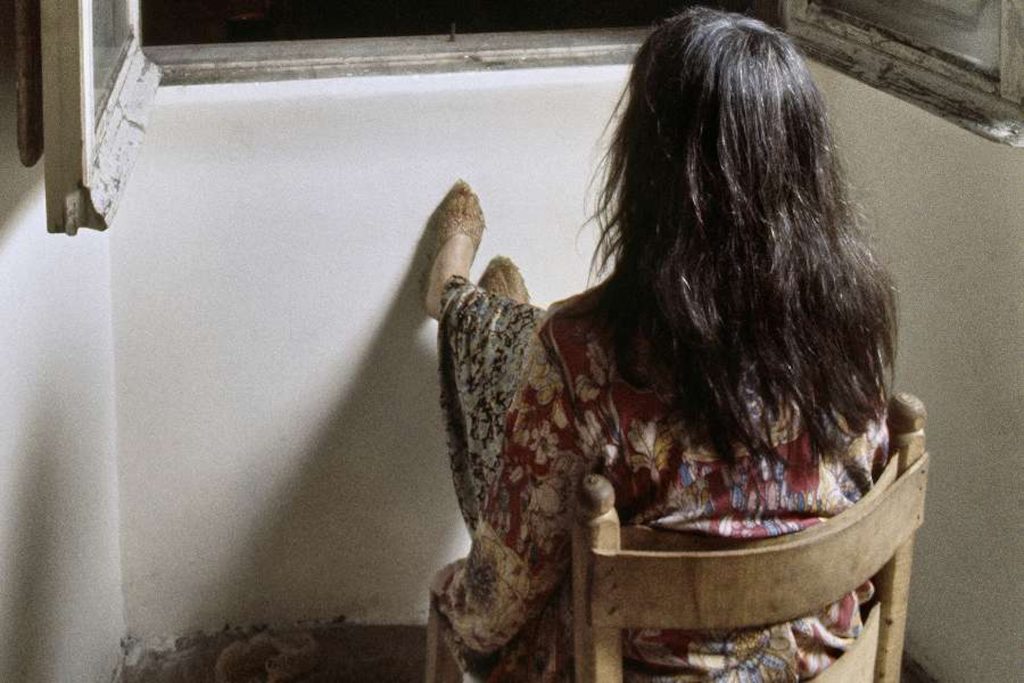
Marisa Merz wearing Scarpette, Galleria L’Attico, Rome, 1975
Photo Claudio Abate
An exhibition in three acts at Castello di Rivoli, Fondazione Merz, and GAM in Turin to mark the centenary of the artist’s birth
Curated by
Chiara Bertola, Sébastien Delot, Francesco Manacorda, Beatrice Merz, Chiara Parisi, Marianna Vecellio
29 October 2026 – 4 April 2027
From 29 October 2026 to 4 April 2027, Castello di Rivoli Museo d’Arte Contemporanea, Fondazione Merz, and GAM – Civic Gallery of Modern and Contemporary Art in Turin present Marisa Merz – La danza delle ore, an exhibition in three acts under the patronage of the Ministry of Culture and made possible thanks to the support of Fondazione CRT. On the centenary of the artist’s birth in 1926, the three institutions retrace her work and legacy through a shared project that interweaves complementary curatorial perspectives and brings together historical works and previously unseen pieces.
At the heart of the exhibition is an artistic practice in which art and life belong to the same movement: everyday time becomes a time of creation and a space for experimentation, while matter remains an ever-open possibility for transformation. Marisa Merz’s works emerge from gestures, intuitions, and returns; they are revisited, juxtaposed, and modified, keeping alive the possibility of taking on new forms and meanings. La danza delle ore conveys this ongoing metamorphosis, offering a reading of the artist’s work in its breadth and in its capacity to continue generating images and thought today.
The three chapters develop three distinct perspectives on this universe. Castello di Rivoli explores the environmental and spiritual dimensions of her practice, space as both a physical and metaphysical place, and the resonances of her research in the work of ten contemporary women artists. Fondazione Merz examines the creative process, the choice of materials, and the balances through which objects and materials reveal unexpected potential. GAM focuses on the home as studio and laboratory, the original setting of a practice in which everyday experience and artistic creation are inseparable.
The three-exhibition itinerary is completed by a new work by Tacita Dean, who was invited to enter Marisa Merz’s home-studio in Turin to create a film and a series of photographs that capture its light, memory, and enduring capacity to generate images and thought. A contemporary perspective on a place that preserves the profound continuity between living and artistic practice.
Castello di Rivoli Museo d’Arte Contemporanea
Curated by Francesco Manacorda and Marianna Vecellio
The exhibition at Castello di Rivoli begins with the reconstruction of E il naufragar m’è dolce in questo mare, the installation presented by Marisa Merz in 1980 at the Tucci Russo gallery in Turin and, in a new version, in the same year at the 39th Venice Biennale. The work forms the core of an exhibition itinerary that, through more than fifty works, including paintings, drawings, installations, and sculptures, explores the environmental and spiritual dimensions of her research and the possibility of art giving form to that which transcends the visible.
The sky, flight, angels, and the feminine run through a universe of images and apparitions in which the exhibition space opens up to a metaphysical dimension. The artwork emerges as an open system, capable of embracing time, fragility, and incompleteness as elements of its own language.
The exhibition itinerary includes contributions by ten contemporary women artists invited for their affinities with Marisa Merz in terms of process or perspective: Leonor Antunes, Micol Assaël, Beatrice Bonino, Miriam Cahn, Tacita Dean, Thea Djordjadze, Lara Favaretto, Daiga Grantina, Armineh Negahdari, and Solange Pessoa. Their practices open up further perspectives on Marisa Merz’s work, bringing to light unexpected aspects and questions that testify to its vitality in the present.
“The exhibition at Castello”, observe Francesco Manacorda and Marianna Vecellio, “emphasises the environmental dimension of Marisa Merz’s practice, giving rise to a polyphonic narrative that speaks of the sky and flight, parallel universes, and the lunar, spiritual, and feminine spheres”.
The exhibition at Castello di Rivoli is supported by Fondazione Tridama.
Fondazione Merz
Curated by Sébastien Delot and Beatrice Merz
Fondazione Merz presents the most unexpected side of the artist’s research through a selection of works organised around the idea of process and transformation. The exhibition focuses on the way the works are composed and on the relationships established between their elements: an apparent imbalance reveals itself to be a precise equilibrium, capable of bringing out the hidden potential of objects and materials.
The works, at times seemingly ephemeral, take shape through subtle variations, juxtapositions, and superimpositions. Metamorphosis concerns both matter and images, which take shape, dissolve, and reassemble, offering new readings of the world. The exhibition thus leads to the generative dimension of Marisa Merz’s work, to the intuitions and experimentation that precede and accompany the creation of her works.
“With this exhibition, Fondazione Merz,” write the curators, “establishes itself as a privileged place dedicated to the unseen and to experimental research: a space in which visitors can access the artist’s most hidden sphere, her nascent thoughts, intuitions, and the silent dialogue that accompanies the creation of her works. What emerges is a deeply personal expressive language, in which high and low, high and popular culture, artistic and everyday practices intertwine to give rise to surprising works, marked by a subtle force.”
GAM – Civic Gallery of Modern and Contemporary Art, Turin
Curated by Chiara Bertola and Chiara Parisi
At GAM, the project focuses on the home, the original setting of Marisa Merz’s practice and a space in which life and art coincide. The exhibition itinerary begins with the idea of domestic space as studio and laboratory: an environment in which reading, conversations, encounters, moments of contemplation, and everyday gestures all form part of the same creative process.
The exhibition design evokes the intimate atmosphere of the places where her artistic research unfolded, bringing historical works into dialogue with a significant body of previously unseen works, originating from the artist’s home or never exhibited before. Copper, thread, fabric, wax, and clay bear witness to the continuous transformation of matter and thought, in which time, gesture, and relationships all contribute to the creation of the artwork.
The exhibition also presents Living Sculpture, 1966, to the public once again. The work, part of the Museo Sperimentale and belonging to the GAM collection, is shown following careful restoration by the Centro Conservazione e Restauro di Venaria.
“The exhibition at GAM,” state Chiara Bertola and Chiara Parisi, “takes shape as an intimate and welcoming space, capable of evoking the domestic dimension. Important historical works coexist with moments of contemplation and introspection, making visible open and constantly evolving creative processes. The exhibition thus becomes a metaphor for artistic practice nourished by relationships and time, in which every element contributes to the creation of the artwork.”
The exhibition will be accompanied by a single catalogue, published by Hopefulmonster and produced with the support of Italian Council (15th edition, 2026), the international promotion programme for Italian art of the Directorate-General for Contemporary Creativity of the Ministry of Culture. The catalogue will be presented on the occasion of a symposium dedicated to the artist.
The Public Program, entitled Marisa Polifonica, conceived and shared by the three museums, will take shape as a constellation of different voices, sounds, and languages.
Marisa Merz – La danza delle ore
Curated by Francesco Manacorda and Marianna Vecellio
Manica Lunga, third floor, and Castello, first floor
At Castello di Rivoli, Marisa Merz – La danza delle ore begins with the reconstruction of the environment E il naufragar m’è dolce in questo mare, an important exhibition project that Marisa Merz presented in 1980 at the Tucci Russo gallery in Turin and presented again in the same year on the occasion of the Venice Biennale. The spatial installation forms the core of the exhibition, from which themes and research emerge relating to the overcoming of the traditional boundaries of exhibition space, the autonomy of forms, and the opening of the artwork towards dimensions that transcend reality.
Around this important core, more than sixty historical and recent works—including small paintings, large canvases, installations in copper and aluminium, sculptures in raw clay, and drawings—recount a vision that does not end with the intimate and domestic dimension most familiar to the public, but develops through a relationship with space. What emerges is a polyphonic narrative that speaks of the sky and flight, of the aerial, lunar, spiritual, and universal sphere, as well as the feminine.
The exhibition traces some significant experiences in Marisa Merz’s artistic research, including those developed in the context of the Roman gallery L’Attico, where in 1970 the artist took part in the action at Aeroporto dell’Urbe: an emblematic experiment in dialogue with the symbolic dimension of flight.
The exhibition also takes the form of an expanded retrospective, with the participation of ten contemporary women artists invited to compose a constellation of voices and positions that resonate with Marisa Merz’s poetic and experimental approach. The dialogue brings to light affinities in process, method, and research. The artists involved are Leonor Antunes (Lisbon, 1972), with her practices of measuring and translating space between modernist memory and craftsmanship; Micol Assaël (Rome, 1979), who investigates invisible forces and physical tensions through sensory experiences; Beatrice Bonino (Turin, 1992), who transfigures the domestic environment through processes of compression and juxtaposition of materials; Miriam Cahn (Basel, 1949), whose painting conveys the urgency of the body and an existential vision; Tacita Dean (Canterbury, 1965), who works with suspended temporalities and the persistence of memory; Thea Djordjadze (Tbilisi, Georgia, 1971), whose unstable forms emerge in relation to the latent energies of space; Lara Favaretto (Treviso, 1973), who reflects on the duration of objects and the ephemeral nature of events; Daiga Grantina (Saldus, Latvia, 1985), who investigates the relationships between materials and the processes of material transformation; Armineh Negahdari (Tehran, 1994), who explores drawing between gesture and fragmented figure; and Solange Pessoa (Ferros, State of Minas Gerais, Brazil, 1961), who activates an organic and ritual dimension of matter, linked to life cycles and cosmologies.
The question that runs through the exhibition is therefore: who is Marisa Merz today? The dialogue between her works and those of contemporary women artists makes it possible to observe her research in all its complexity and shows how her practice continues to generate resonances, questions, and possibilities for vision and thought.
On the occasion of Marisa Merz – La danza delle ore, the Fondazione Cerruti’s Interferenze project brings the two institutions into dialogue through an exchange of artworks: a sculpture (Senza titolo, n.d.) and a work on paper (Senza titolo, 2010–2012) by Marisa Merz are presented in the rooms of the Cerruti Collection, while Castello di Rivoli hosts Angelo annunciante, Redentore, Vergine annunciata by Agnolo Gaddi (1387–88), on loan from the Cerruti Collection.
Marisa Merz – La danza delle ore is held under the patronage of the Ministry of Culture and is realized with the support of Fondazione CRT

The exhibition at Castello di Rivoli is supported by Fondazione Tridama
Partner