Mutual Aid – Art in Collaboration with Nature
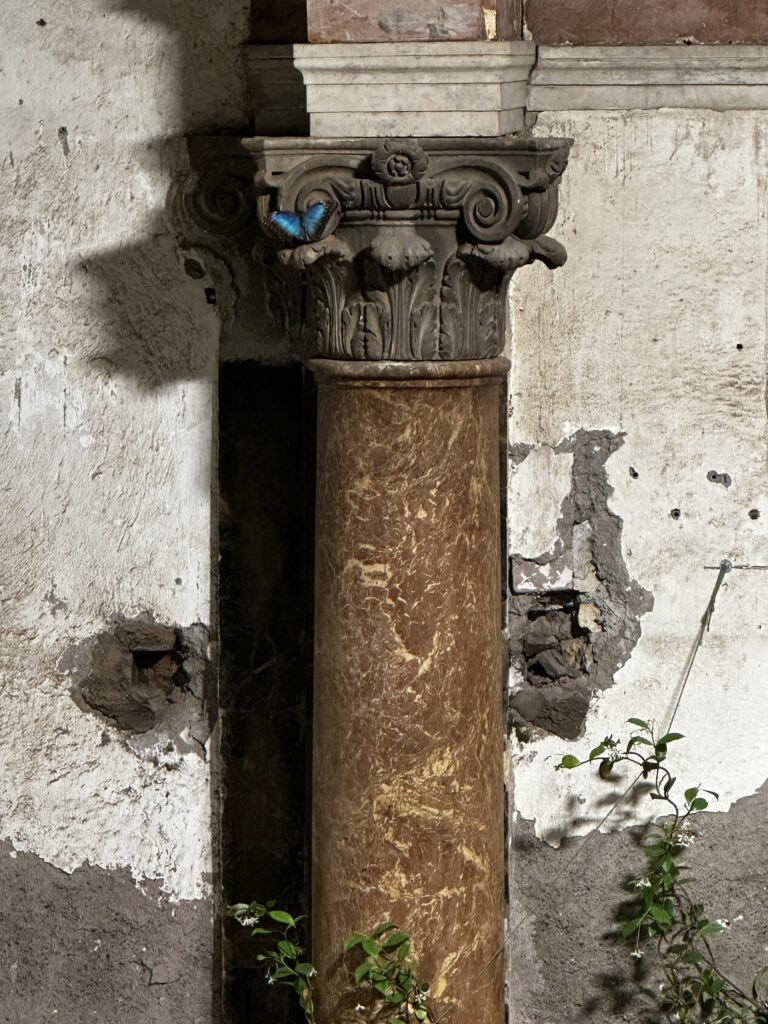
Precious Okoyomon
the sun eats her children, 2023 (detail)
wild flowers, volcanic soil, butterflies, resin bear sculpture composed of animatronics parts
dimensions variable
Photo: Sant’Andrea de Scaphis
© Precious Okoyomon
Courtesy the artist, Sant’Andrea de Scaphis, and Gladstone Gallery
Curated by Francesco Manacorda and Marianna Vecellio
31 October 2024 – 23 March 2025
Castello di Rivoli Museo d’Arte Contemporanea presents Mutual Aid – Art in Collaboration with Nature, a large-scale exhibition project dedicated to multispecies vision, curated by Francesco Manacorda and Marianna Vecellio. The exhibition is open to the public from Thursday 31 October 2024 until Sunday 23 March 2025.
The exhibition, conceived specifically for Castello di Rivoli’s Manica Lunga space, explores the concept of mutual aid by delving into the creative collaboration between humans and nature. It offers a unique perspective to the public through the experiences of over twenty artists and their non-human collaborators, who have addressed this theme from the 1960s to today: Maria Thereza Alves, Michel Blazy, Bianca Bondi & Guillaume Bouisset, Andrea Caretto & Raffaella Spagna, Castor fiber, Agnes Denes, Hubert Duprat, Echinoidea, Fraxinus, Henrik Håkansson, Halobacterium, Heliconius doris, Helix pomatia, Tamara Henderson, Hypolimnas bolina, Aki Inomata, Renato Leotta, Lumbricus terrestris, Nicholas Mangan, Yiannis Maniatakos, Myscelia cyaniris, Nour Mobarak, Morpho Menelaus, Nephila senegalensis, Nerium oleander, Precious Okoyomon, Plankton, Giuseppe Penone, Tomás Saraceno, Robert Smithson, Vivian Suter, Trametes versicolor, Trichoptera, Natsuko Uchino and others.
The title of the exhibition originates from the theories of Russian philosopher Piotr Kropotkin (1842–1921), as summarised in his 1902 essay Mutual Aid: A Factor of Evolution. In contrast to the ideas of his contemporary, Charles Darwin, who saw competition as the driving force of evolution, Kropotkin proposed that, in an unstable environment with limited resources, the best survival strategy is collaboration between species. The “mutual aid” between the various elements at play thus becomes the key factor in evolution – as well as the heart of the exhibition at Castello di Rivoli, where each work is either completed or co-created through the contributions of non-human elements or agents.
The exhibition invites viewers to reconsider the division between culture and nature, between the environment and humanity. Drawing on various media such as video, painting, sound, installation, and sculpture, Mutual Aid – Art in Collaboration with Nature explores visions that seek new ways of collaborating with other species, transforming the Manica Lunga into a “living” organism where artworks and natural processes cooperate to create a truly evolving exhibition.
THE EXHIBITION
The exhibition opens with the monumental canvases of Vivian Suter (Buenos Aires, 1949), created in the heart of the Guatemalan rainforest. Suspended in the space of the Manica Lunga, her works carry visible traces of nature, from tropical rains to marks left by animals. Suter entrusts the creative process to the surrounding environment, establishing a dialogue between the artwork and nature that challenges the notion of exclusively human authorship.
Suter’s work is succeeded by two historical sections conceived as tributes to the pioneering practices of Giuseppe Penone (Garessio, 1947) and Agnes Denes (Budapest, 1931). Among the pioneers of art in dialogue with nature, Giuseppe Penone presents works from the Alpi Marittime series, resulting from his artistic actions in the forests of Garessio. The sculpture Trattenere 24 anni di crescita (Continuerà a crescere tranne che in quel punto) (To Retain 24 Years of Growth – It Will Continue to Grow Except at That Point), 1986–2010, created from a walnut tree trunk, documents the artist’s collaboration with the tree, exemplifying his concept of “biological time” where human and natural processes merge. Agnes Denes, a pioneer of Land Art, presents two historical projects: Rice/Tree/Burial, 1977-2012, which explores the connection between human action and the landscape through agricultural and burial rituals, and the series Tree Mountain – A Living Time Capsule, started in 1992, a monumental reforestation project involving the planting of 11,000 trees in a mathematical pattern, reflecting on the resilience of the landscape and the concept of “living time.”
Tomás Saraceno (San Miguel de Tucumán, Argentina, 1973) has long explored interspecies collaboration in his practice. On display is a selection of works never before exhibited, created by various species of spiders in his studio. The webs, dusted with graphite powder, are not only sculptural elements but also perceptual tools that invite the viewer to reflect on the silent coexistence between human and non-human creatures.
The theme of species cohabitation is central to the work of artists such as Maria Thereza Alves (São Paulo, Brazil, 1961), who aims to create spaces of representation for oppressed human and non-human voices and communities. Her watercolour series, exhibited at Castello di Rivoli, stems from the artist’s investigation into endangered species in the Piedmont landscape. The idea of refuge is also central to Hubert Duprat’s (Nérac, Lot-et-Garonne, France, 1957) poetic, where interaction with the non-human world takes the form of collaboration with caddisfly larvae, insects that construct protective cases using precious materials provided by the artist, such as pearls, gold, and stones.
The exhibition continues with Nour Mobarak (Cairo, 1985) and her series of sculptures Gods’ Facsimiles, 2023, in which the Trametes versicolor fungus directly intervenes with the materials, transforming the sculptures into living organisms that mutate, decompose, and recompose. The work evokes the myth of the nymph Daphne to explore the transience of matter and the natural cycle of life and death.
At the same time, Japanese artist Aki Inomata (Japan, 1983), with the work How to Carve a Sculpture, 2018–ongoing, explores the relationship between nature and technology, starting from the behaviour of the Eurasian beaver. Drawing inspiration from the animal’s dam-building techniques, Inomata presents a series of hand- and machine-made sculptures that echo the complex wooden architectures produced by the animals. Tamara Henderson (New Brunswick, Canada, 1982) also shines a light on generally silent and hidden natural processes. In Worm Affair, 2023, visitors can listen to the sounds produced by Lumbricus terrestris as they burrow and transform matter, a nod to the cycles of decomposition and regeneration that sustain life.
Andrea Caretto & Raffaella Spagna (active since 2002), showcase their work Être galet (Being pebble), 2011, the result of an investigation into the Rhone River where the artists collected synthetic and natural materials transformed by the current. These “artificial pebbles” narrate the tension between human intervention and the natural force of the river. The interactive installation Sensitive Stones: Project for an Experiential Lithotheque, 2023–ongoing, invites the public to take a stone polished by the artists at the museum’s library.
Michel Blazy (Monaco, 1966) continues the exhibition with his exploration of processes of decay and the metamorphosis of organic matter. At Castello di Rivoli, he presents Le lâcher d’escargots (The snail release), 2009, an environmental installation involving snails that traverse a carpet, leaving trails reminiscent of abstract painting intersections.
The theme of sustainability and ecosystem resilience is fundamental to the work of Nicholas Mangan (Geelong, Australia, 1979), who explores the impact of climate change on the Great Barrier Reef. In Core-Coralations, 2022-2023, Mangan reflects on the transformations corals undergo due to rising ocean temperatures, while the sculpture Sarcophagi, 2023, simulates an ossuary built with bleached coral skeletons, emblematic of the fragility of marine ecosystems.
The exhibition continues with a reflection on the interactions between nature and creative processes, beginning with the painterly works of Yiannis Maniatakos (Flomochori Mani, 1935 – Athens, 2017). Since 1967, the artist has pioneered underwater painting sessions in the depths of the Aegean Sea, a collaboration between painting and the sea. The relationship between artistic expression and chemical processes is at the heart of Source and Origin, Lecce Stone, 2024, by Bianca Bondi & Guillaume Bouisset (Johannesburg, 1986; Madrid, 1990), an installation created with earth, salt, and halobacteria from the salt marshes of the Camargue. Halobacteria, known for their role in the progressive de-pollution of the environment through degradation of heavy metals, transform the work into a living organism that continuously evolves, changing color and composition over time.
Renato Leotta (Turin, 1982), with the series Gipsoteca, 2012–ongoing, presents plaster casts that record the movements of the sea on Mediterranean coasts, creating a sensitive mapping of natural forces. In the work Self-portrait of Plankton, 2023, Leotta harnesses the bioluminescence emitted by marine microorganisms to produce a photographic trace, intertwining art and natural phenomena in a dialogue between light and water.
Participation and sustainability processes underpin the practice of Natsuko Uchino (Kumamoto, Japan, 1983), who presents an environment created specifically for this exhibition with natural materials such as earth, brushwood, tree segments, and beeswax to host moments of interaction with the public, sharing kefir and other forms of communal rituals. Henrik Håkansson (Helsingborg, Sweden, 1968) also aims to reduce the distance between human beings and nature, proposing a new commission that reinterprets Bruce Nauman’s Corridor. Håkansson’s structure is made inaccessible to man and activated instead by the presence of vegetation, which becomes the protagonist of the work, reflected in infinity.
A focus is dedicated to the work of Robert Smithson (Passaic, New Jersey, 1938 – Amarillo, Texas, 1973), centered on themes such as entropy, time, and the interaction between human and non-human forces. On display for this occasion is the Overgrown Structure photographic series, 1971, taken by the artist in Florida during the 1970s and never before exhibited in Europe. These images depict the local practice of shielding plants from extreme heat through the use of nets and coverings.
The journey culminates in Precious Okoyomon’s (London, 1993) immersive installation the sun eats her children, 2023, in which a tropical greenhouse hosts butterflies and poisonous plants in a surreal landscape. The work, evoking stories of slavery and resistance, transforms the natural environment into a powerful symbol of strength and regeneration, blending dystopian and historical elements.
Mutual Aid – Art in Collaboration with Nature also extends to Collezione Cerruti, which hosts the first episode of the Interferences series. This programme brings Castello di Rivoli’s exhibitions into the fabric of Villa Cerruti through a hypertextual connection that highlights both the interdependence and the affinities and differences between the two spaces. Works by Henrik Håkansson, Renato Leotta, and Natsuko Uchino will infiltrate the refined and precious environments of the Collezione Cerruti, shedding light on some of its lesser-known aspects.
Mutual Aid – Art in Collaboration with Nature is a sustainable exhibition. In order to minimise the environmental impact of the project, the museum prioritised transport solutions that did not include air shipment. For this reason, Nicholas Mangan’s sculptural work will be installed after the exhibition’s opening, as the museum and the artist opted for sea transport, resulting in delays. Additionally, the installation of the project made use of locally produced exhibition copies, employing recycled and recyclable materials and energy, while consulting experts to ensure the well-being of all species involved.
GENERAL INFORMATION
Mutual Aid – Art in Collaboration with Nature
Curated by Francesco Manacorda and Marianna Vecellio
31 October 2024 – 23 March 2025
Castello di Rivoli Museo d’Arte Contemporanea
Piazza Mafalda di Savoia – 10098 Rivoli (Torino)
www.castellodirivoli.org | T. +39 011.9565222 | info@castellodirivoli.org
Opening hours
From Wednesday to Friday, from 10am until 5pm
Saturday, Sunday and public holidays, from 11am until 6pm
Supported by
