Rebecca Horn – Cutting Through the Past
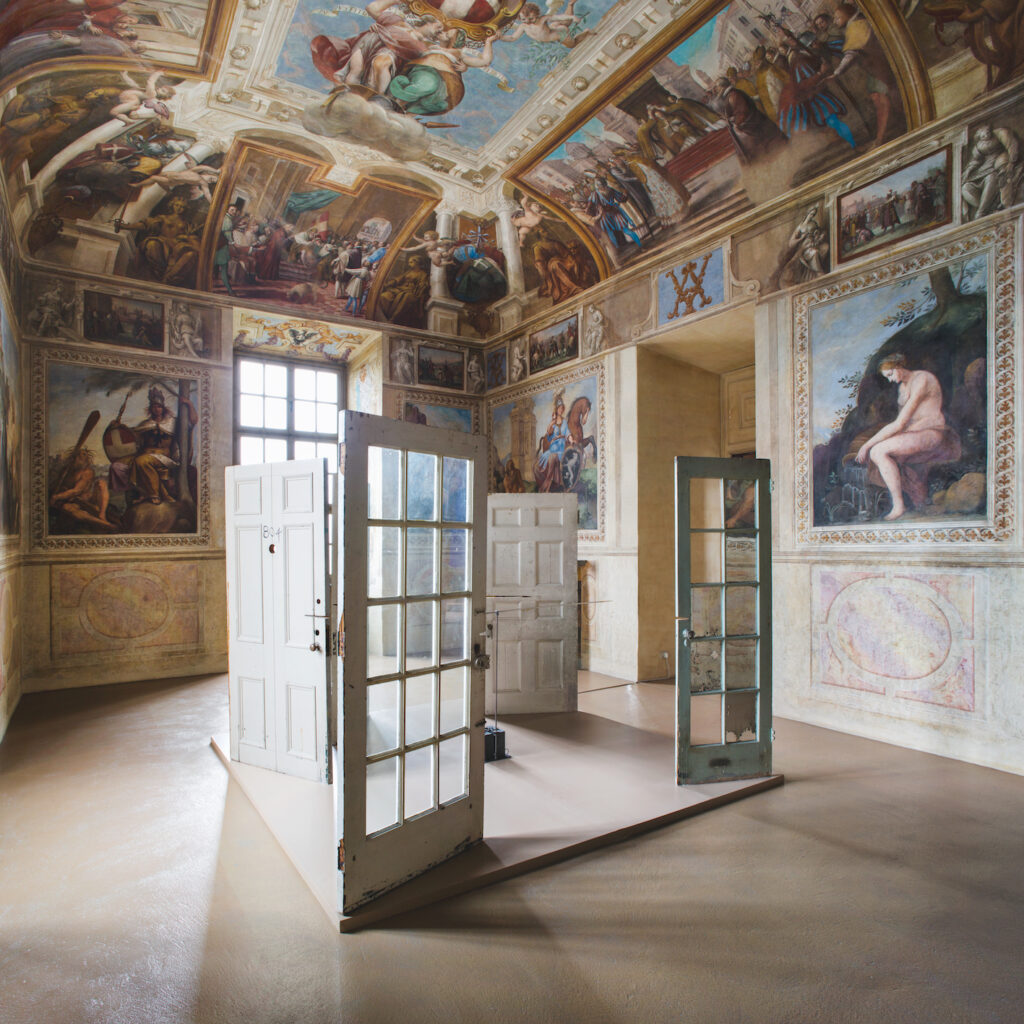
Cutting Through the Past, 1992–1993
5 doors, metal shaft, motor
220 x 307 x 306 cm
Castello di Rivoli Museo d’Arte Contemporanea,
Rivoli-Torino
Gift Fondazione Marco Rivetti
Photo Renato Ghiazza
© REBECCA HORN, by SIAE 2025
Exhibition curated by Marcella Beccaria
23 May—21 September 2025
Castello di Rivoli Museo d’Arte Contemporanea is pleased to announce Rebecca Horn – Cutting Through the Past. The exhibition, curated by Marcella Beccaria, is the first retrospective dedicated to the artist in an Italian museum and the first major exhibition following her recent passing. The project is the result of a cooperation between Castello di Rivoli and Haus der Kunst, Munich, following the artist’s solo exhibition organised by the same institution in 2024.
Rebecca Horn – Cutting Through the Past acknowledges the fundamental role of Rebecca Horn (Michelstadt, 1944 – Bad König, Germany, 2024) in the development of contemporary artistic practice, through works that have a highly performative quality, in which key themes such as time, memory, desire, and power relations take centre stage. Rebecca Horn’s work presents an inseparable intertwining of the human and the mechanical, anticipating issues at the heart of current cultural debates, in a context defined by technologies and machines that tend to become extensions of ourselves.
The exhibition, whose title refers to one of the artist’s major installations in the Castello collection, presents over 35 works by Rebecca Horn, including installations, sculptures, videos, films, and drawings, spanning from her early works in the 1960s to more recent pieces. The exhibition also features important loans of rarely exhibited works from the Moontower Foundation, originally established in Germany by the artist herself. The exhibition includes iconic kinetic machines such as Pfauenmaschine (Peacock Machine), originally created by the artist for her participation in documenta, Kassel in 1982, as well as the recent Hauchkörper (Breathing Body), 2017, along with monumental installations such as Inferno, 1993-2024, Turm der Namenlosen (Tower of the Nameless), 1994, and Concert for Anarchy, 2006.
In the central section of the exhibition, visitors will be able to see Horn’s early performances through the videos Performance I, 1970-1972, Performance II, 1972, and Berlin (10.11.1974 – 28.1.1975), 1974-1975. Recently digitised, these will be projected on a large scale, creating a continuous landscape. Highlighting a core group of important works by Horn from the Castello collection, the exhibition also features the film Der Eintänzer (The Gigolo), 1978, and the engaging installations Cutting Through the Past, 1992-1993 (the work from which the exhibition takes its title), and Miroir du Lac (Mirror of the Lake), 2004.
The exhibition at Castello also places particular emphasis on her drawings, a practice that has accompanied her since the beginning. The show includes rare drawings created from 1964, as well as an important group of Bodylandscapes. Among Horn’s final works, these large-scale painted drawings emerge from a performative process. The selection highlights the recurring presence of rounded forms and circles, which can be interpreted as symbols of time conceived as a cyclical and non-linear entity, as well as allusions to endless regeneration. Along with the installation Das Rad der Zeit (The Wheel of Time), 2016, also presented for the first time in a public museum, these works manifest Horn’s spiritual dimension, in line with a body of work that includes Piccoli Spiriti Blu, the major public work that, since 2000, has marked the landscape of Turin from the top of the Church of Santa Maria al Monte dei Cappuccini.
In conjunction with the exhibition in the Manica Lunga, a wall work by the artist is again on public view after being hidden for many years. Almost a secret gesture, the drawing was produced by the artist in the mid-1990s while she was at Castello.
On the occasion of Rebecca Horn – Cutting Through the Past, works by the artist will also be featured at the Cerruti Collection, as the second episode of Interferenze, a programme focused on the affinities and differences between Castello di Rivoli and Villa Cerruti. For this occasion, the selection of works, including a large Bodylandscape and installations, will feature Cello, 1999. Originally presented by the artist in Weimar as part of the major project Konzert für Buchenwald (Concert for Buchenwald), this work, conceived as a cello that plays itself with two bows, will be displayed in the music room of the Villa.
Francesco Manacorda, Director of Castello di Rivoli, states: “Rebecca Horn had a special relationship with Castello di Rivoli, having participated in four exhibitions, including the inaugural one in 1984. We are honoured to celebrate this connection with a major show that highlights the significance and boundless visionary quality of this beloved artist, particularly known in Turin for her iconic intervention at Monte dei Cappuccini.”
Marcella Beccaria, Deputy Director of the Museum and curator of the exhibition, states: “Rebecca Horn demonstrated the ability, characteristic of great artists, to bend techniques and languages to her will, anticipating multiple areas of contemporary research that span from multispecies thinking to the new horizons that are emerging, with technologies that exhibit behaviours akin to human emotions.”
The exhibition is the result of a cooperation between Castello di Rivoli Museo d’Arte Contemporanea, Rivoli-Turin, and Haus der Kunst, Munich, where it was curated by Jana Baumann.
Special Screenings
24 and 25 May 2025, from 2 pm to 5 pm
In synergy with EXPOSED and the theme of the 2025 edition Sotto la superficie – Beneath the Surface, Castello di Rivoli organises a series of screenings dedicated to the films of Rebecca Horn, presenting them in its Theatre on Saturday 24 May and Sunday 25 May 2025. The programme includes the screening of two feature films written and directed by the artist, which are part of the Museum’s Collection: Buster’s Bedroom, 1991, and La Ferdinanda – Sonate für eine Medici Villa (La Ferdinanda – Sonata for a Medici Villa), 1981.
Free entry until seats are filled with a museum entrance ticket.
With thanks to Gianfranco D’Amato for his support of the exhibition
With thanks to Goethe–Institut Mailand and Laura Trisorio, Studio Trisorio, Naples