Research Event: Living Oceans
23.09.2018 from 14:00 to 19:30
Event is free for Museum ticket holders
On the occasion of Terra Madre, a Slow Food project dedicated to the culture of food as a responsible act, the Castello di Rivoli Museum of Contemporary Art presents, in collaboration with TBA21 Academy, Living Oceans, a day of interdisciplinary study and performative lectures dedicated to the discovery of the marine ecosystem, its biodiversity and its delicate balance with the participation of the American artist Joan Jonas, the duo artists Cooking Sections, the Italian artist Elena Mazzi, the Professor Jeffrey Peakall, the marine biologist Dr. Dayne Buddo and the farm-to-table Stush in the Bush.
Terra Madre Salone del Gusto will take place from 20 to 24 September 2018 in Turin. It is organized by Slow Food, City of Turin and Piedmont Region, in collaboration with the Ministry of Politics Agricultural and Forestry Activities and with the involvement of the Ministry of Cultural Heritage and Activities and of Tourism, as part of the activities planned for the “year of Italian food”.
Food for Change is the theme of the 2018 edition, starting from the project itself, widespread and open, up to the contents of the forums and conferences. One of the five thematic areas of this year is Slow Fish. According to Terra Madre, in 2014 European countries spent 34.57 billion to buy fish products. In total, 7.5 million tons of fish are consumed each year in European countries (33.4 kilos per capita compared to the average of 19.2 kilos consumed globally). Of these, 2.75 million tons are locally fished, the remaining 5 million are imported products.
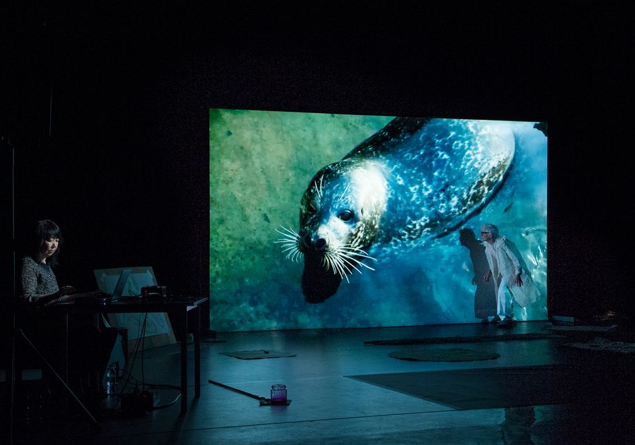
Living Oceans, hosted in the museum’s theater, will be an opportunity to preview Moving off the Land. Oceans – Sketches and Notes, the new work by the American artist Joan Jonas that is supported by TBA21 and will be presented in its final version in 2019.
Recently exhibited by a major exhibition at the Tate Modern in London, Jonas is one of the most important contemporary artists and a pioneer of video and performance art, which emerged in the late 60s and early 70s. Castello di Rivoli hosted a solo exhibition of Jonas’ work in 2006.
Produced by TBA21-Academy born from the desire to promote cross-cultural projects, this new work by Jonas is a hypnotic combination of images of underwater life, sounds and drawings, which will merge in the exhibition promoted by the Austrian foundation for the summer of 2019 in Church of San Lorenzo in Venice, at the same time as the 58th International Art Exhibition La Biennale di Venezia.
To foster a transdisciplinary debate around the subject, Living Oceans also invite personalities from the artworld and the science and sustainable agriculture communities to intervene. These are Jeffrey Peakall, Professor of Sedimentology Processes at the University of Leeds, Dr. Dayne Buddo, marine ecologist and biologist with expertise in invasive alien species and marine biodiversity, the duo artists Cooking Sections (Daniel Fernández Pascual & Alon Schwabe), the Italian artist Elena Mazzi and Lisa and Christopher Binns who founded the organic farm Stush in the Bush in Jamaica.
NB: Exceptionally, the bus Rivoli Express will depart from Castello towards Turin at 7.10pm.
Program schedule
14.00
Introduction by Carolyn Christov-Bakargiev, Castello di Rivoli Museo d’Arte Contemporanea
14.20
Markus Reymann, Thyssen-Bornemisza Art Contemporary (TBA21)| TBA21-Academy | Presenting Oceans. Imagining a Tidalectic Worldview
14.45 – 15.15
Cooking Sections, CLIMAVORE: On Tidal Zones
For the Terra Madre event at Castello di Rivoli Cooking Sections (Daniel Fernández Pascual and Alon Schwabe) will present a new version of their lecture-performance, CLIMAVORE: On Tidal Zones which focuses on sea pollution by fish farms and the cultural construction of “Scottish Salmon”, looking specifically into the case of the Isle of Skye. Commissioned by Atlas Arts, the project investigated the detrimental effects of salmon farming and explored alternative ecological imaginaries. The resulting installation consisted of an “oyster table”—home for 1,000 common oysters on the tidal zone filtering thousands of liters of water daily at high tide. As the structure emerged out of the water at low tide, it served as a dining table for humans, where performative lectures, public workshops and tastings allowed participants to discuss alternative aqua-cultures. The project is evolving into a permanent installation there titled The Climavore Centre(scheduled to open 2019-2020).
15.15 – 15.30
Elena Mazzi, Reflecting Venice (2012-2014) and Becoming with and Unbecoming with (upcoming)
The artist presents a first project about the history of Venice and its lagoon, which is threatened by mass tourism and industrial exploitation, to look for a possible sustainable future. Starting from a biographical episode, the second project presented, still in progress, examines the life of cetaceans in conjunction and conflict with the forces of nature to investigate how different species can relate to each other.
15.30 – 16.00
Jeffrey Peakall, Underwater Rivers: An Underexplored Habitat
The world’s oceans are traversed by a range of seafloor channels that can extend for hundreds, or in some cases thousands, of kilometers. These underwater rivers are typically found on ocean floors at several kilometers water depth, where they can be kilometers wide, and sit up to a hundred meters above the surrounding seafloor. These channels can exhibit rare but extremely powerful flows that are poorly understood, due to their great depth, and the difficulty of measuring such flows. Flows in these underwater rivers are known to be important for the transport of organic carbon, nutrients, and pollutants. They can also have major effects on marine organisms, although much of our knowledge comes not from the modern but from ancient rocks, where we see the traces of a range of organisms. Recent experiments have shown that many of these organisms survive transport in these extreme flows and then live on the seafloor for some time, utilizing the nutrients that the flow has brought in.
16.00 – 16.30
Dayne Buddo, Marine Protected Areas: An Opportunity to Press the Reset Button
Marine Protected Areas (MPAs) are critical to improving the resilience of marine ecosystems. They are also a mechanism to reverse some of the negative anthropogenic impacts on the marine ecosystem. We have now finally paid attention, simply for the primary reason that the poor state of the marine environment is significantly affecting the ecosystems services it provides to humans. We have lost sight of the value of using a resource without losing that resource. Fish stocks are a renewable resource, but we must realize that it is only renewable once we give it the opportunity to do so. The Conservationists and the Fishing Industry both want the same thing, healthy and sustainable fish stocks, therefore we must work together to achieve this common goal. The number of marine scientists has increased significantly over the past 30 years, while ironically, the state of the marine environment has declined to alarming levels. Governments have committed to protecting 30% of the marine environment by 2030, but the real work will be done by the local communities. Many MPAs are managed not by Governments, but by local environmental NGOs and local communities, which despite glaring gaps in institutional capacity, have improved the MPAs and are showing success towards sustainable fisheries. We have an opportunity to change the current trajectory of the world’s marine ecosystems; imagine what we can achieve when we take this seriously.
16.30 – 17.00
Joan Jonas documentary Moving off the Land: Oceans – Sketches and Notes, 2018 Tate Modern, Londra, 2018. A multi-layered performance exploring the poetics and ecology of ocean life.
17.00 – 18.00
Conversation between Joan Jonas and Jeffrey Peakall, moderated by Carolyn Christov-Bakargiev
18.00 – 19.00
Stush in the Bush, Sexy Vegetarian
Lisa and Christopher Binns take us on a culinary journey that enhances the knowledge of vegetables, their hidden powers and their varying textures and flavors to trigger a sensory and sensual appeal in the public. The Binns promote sustainable agriculture based on respect and love for soil and its products.
Closed-doors symposium with wine (*)
20.30
Dinner
(*) All proceedings, including the closed-doors symposium will be recorded
Biographies
Dayne Buddo is Marine ecologist and Biologist. He currently holds a Bachelor of Science (Hons.) degree in Zoology and Botany and a Doctor of Philosophy degree in Zoology – Marine Sciences from The University of the West Indies (UWI Mona – Jamaica). Dr. Buddo served the UWI as Lecturer and Academic Coordinator 2009-2017, and was stationed at the UWI Discovery Bay Marine Laboratory and Field Station with responsibility for Marine Research and Teaching. He has published several pieces of work on marine invasive species and fisheries management in the region, including the co-authored book on Lionfish Management in the Caribbean.
In addition to marine invasive species, Dr. Buddo also has significant research interests in marine protected areas management, seagrass ecology, fisheries management and sustainable development. He has been a consultant for marine projects for CARICOM, Government of Japan, the World Bank, International Maritime Organization, the Nature Conservancy, among others, and has conducted work in over 30 countries. He has worked closely with the United Nations Convention on Biological Diversity (UNCBD), International Union for the Conservation of Nature (IUCN), United Nations Environment Programme (UNEP), and the Global Environment Facility (GEF), The National Oceanic and Atmospheric Administration (NOAA) among other multilateral agencies.
Joan Jonas graduated from Mount Holyoke College in 1958 and then graduated from Columbia University in 1965. Jonas has exhibited in solo exhibitions at prestigious institutions including the Stedelijk Museum, Amsterdam (1994), the Staatsgalerie, Stuttgart (2000), Queens Museum of Art, New York (2003) e the Bicocca Hangar, Milan (2014). In 2015, the artist represented the United States at the 56th International Art Exhibition The Venice Biennale and in 2018 the Tate Modern in London dedicated a large exhibition to her with an extensive program of performances and film screenings, organized later also at the Haus der Kunst in Munich. Jonas has participated in numerous group exhibitions such as Documenta V, VI, VII in Kassel, Germany and was commissioned to develop an installation and then a performance entitled Lines in the Sand for Documenta XI, then revived at the Tate Modern in London and Kitchen of New York in 2004. In 2009, the artist was awarded the first annual Lifetime Achievement Award of the Guggenheim Museum. Jonas has exhibited in numerous other institutions such as: Haus der Kulturen der Welt, Berlin; Sigmund Freud Museum, Vienna; Dia: Beacon, Beacon, New York; Fundacion Botin, Santander; Museo Nacional Centro de Arte Reina Sofia, Madrid; Museu d’Art Contemporani de Barcelona, Barcelona; Le Plateau and Jeu de Paume / Hôtel de Sully, Paris; Renaissance Society, University of Chicago, Chicago, Illinois; CCA Kitakyushu, Kitakyushu, Japan.
Elena Mazzi is an artist, whose research explores the relationship between man and the environment through an anthropological analysis that investigates the concept of identity of places and people. With the Atlante Energetico project, presented at the Spinola Banna Foundation in 2017, he tackled the topic of energy declined in the Piedmont area, placing rice at the center of his research. He studied History of Art at the University of Siena, then obtaining a degree in Visual Arts at the IUAV of Venice. He spent a period of study abroad at the Royal Academy of Art (Konsthogskolan) in Stockholm.
Jeff Peakall teaches Sedimentology Processes at the University of Leeds. His research fields range from natural processes to industrial systems. He is director of the Environmental Fluid Dynamics Laboratory of Sorby, a national research facility recognized by NERC (Natural Environment Research Council) that studies environmental fluids in the United Kingdom. Peakall has specialized in the study of giant channels that cross the sea floor of the world, focusing on the evolution of the submarine channel, on the sedimentation and on the dynamics of the flow of currents that pass through these systems. Peakall measured flows through active submarine channels in the Black Sea and in a reservoir on the Yellow River in China.
Markus Reymann is Director and Co-Founder of TBA21-Academy. Trained as an actor, Markus successfully performed on screen and stage for many years, in major productions. In 2011, Markus joined TBA21 and, together with the founder and Chairperson Francesca von Habsburg, co-founded TBA21-Academy where he subsequently took on the role of a director. As a central programming unit of TBA21, TBA21-Academy’s mission is to foster interdisciplinary dialogue and exchange surrounding the most urgent ecological, social, and economic issues facing our oceans today. As Director, Markus has overseen the non-profit’s engagement with artists, activists, scientists, and policy-makers, resulting in the creation of new commissions, new bodies of knowledge, and new policies advancing the conservation and protection of the oceans. From July 2011 to present he has initiated and conducted numerous expeditions. Each trip is designed as a collaboration with invited artists, scientists and thinkers eager to embark on oceanic explorations. Inspired by this unusual encounter with both human and natural elements, the Academy commissions ambitious projects informed by the itinerary of the research vessel Dardanella. In June of 2016 TBA21-Academy was granted Observer Status at the International Seabed Authority, becoming the first art organization ever to be given this status. This allows TBA21–Academy to contribute to the international climate change agenda on a policy making level. Markus has presented and participated in conferences around the world, including the Conference of Parties 23 (COP23) part of the United Nations Framework Convention on Climate Change (UNFCCC), the International Seabed Authority 24th Session and The United Nations Ocean Summit in 2017.
Cooking Sections (Daniel Fernández Pascual and Alon Schwabe) is a duo of professionals based in London, interested in exploring the systems that organize the world through food. Using the installation, mapping and video, their research-based practice explores the boundaries between visual arts, architecture and geopolitics. Cooking Sections exhibited in the United States Pavilion, 2014, for the 14th International Architecture Exhibition La Biennale di Venezia. Their work has also been exposed to: XIII Sharjah Biennial; Neue Nationalgalerie in Berlin; Storefront for Art & Architecture New York; dOCUMENTA (13); Peggy Guggenheim Collection; CA2M, Madrid; The New Institute, Rotterdam; UTS, Sydney; ETSAM; TEDx Talks Madrid; Fiorucci Art Trust, London; ACC Weimar; SOS 4.8; HKW Berlin; Akademie der Künste, Berlin; Biennale 2014 INTERIEUR Courtrai; and have resided in The Politics of Food at the Delfina Foundation, in London. Their work has been presented in several international publications (including Lars Müller, Sternberg Press, Volume, Frieze Magazine).
Stush in the Bush (Lisa and Christopher Binns) is a farm-to-table located on a 15-acre organic farm called Zionites on the Free Hill, in St. Ann Jamaica. Combining Rastafari Ital farming, exotic vegetables and a love of fine dining, Stush in the Bush is a sustainable business based on the production and selling of organic and local food.
Organized in collaboration with TBA21-Academy for Terra Madre, a Slow Food project.

Photo credit: Joan Jonas, Moving off the Land: Oceans – Sketches and Notes, 2018
Tate Modern, Londra, 2018, photo by Brotherton-Lock