Carol Rama: Chapter 1 – Dorina and the others
Carol Rama
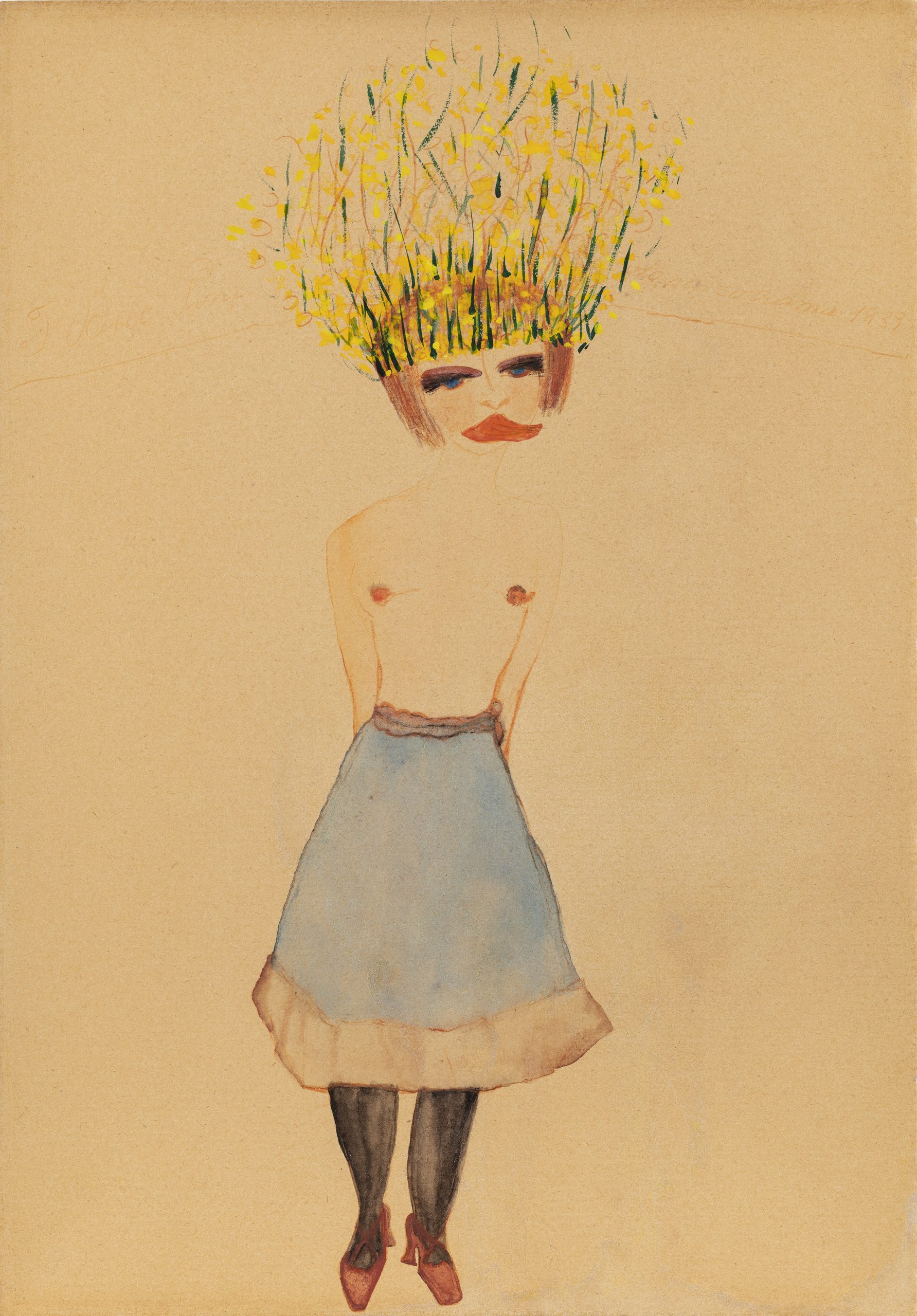
I due Pini (Appassionata) (La signora Macor) (TheTwo Pines – Passionate – Mrs. Macor), 1939
© Archivio Carol Rama, Torino
Photo Pino Dell’Aquila
Curated by Marcella Beccaria
In collaboration with Archivio Carol Rama, Torino
From 29 October 2026
Castello building, second floor, room 29
Castello di Rivoli dedicates a multi-year project to Carol Rama: a monographic gallery that will evolve over time.
Carol Rama pursued an unceasing artistic quest that unfolded across a succession of distinct yet interconnected phases. An original creator of an extensive iconography, she produced both figurative and abstract works, using materials and supports that ranged from the most traditional to the entirely unconventional. This coherent incoherence, together with the close relationship between her life and her art, and the nature of the themes she explored — including psychological distress, eroticism and illness — establish Rama as one of the greatest artists of the twentieth century. Her influence extends powerfully into the present, reaching younger generations of artists.
In recognition of the enduring vitality of Rama’s work, Castello di Rivoli is dedicating a monographic gallery to the artist, featuring important works from private collections. Curated by Marcella Beccaria, the project conceives the gallery as a dynamic space which, from autumn 2026 and over the following three years, will host a succession of exhibition chapters. “This multi-year project,” says Beccaria, Vice Director of Castello di Rivoli, “seeks to explore the multiplicity of Carol Rama’s artistic production and her distinctive ability to reinvent herself periodically, working in cycles of works characterised by unexpected changes, eclecticism and abrupt ruptures. The idea is to conceive of the museum gallery dedicated to Carol as a dynamic space in which, on several occasions, works by the artist from different periods will be brought into dialogue, alongside documentary material. In this sense, the gallery also sets out a perspective that looks at the past from the standpoint of the present, without being confined to a linear chronology.”
The first chapter, Dorina and the others, presents a selection of significant figurative watercolours on paper from the artist’s early years, alongside works incorporating rubber inner tubes, part of the abstract, mixed-media experiments she began developing in the 1970s.
Signed olgacarolrama or carolrama and dated by the artist to the period spanning from 1936 to 1946, Rama’s works on paper—eight of which, dating from 1939 to 1941, are presented at Castello di Rivoli—are characterised by delicate lines and soft colours. Their gentleness contrasts with the provocative poses and erotic references that recur among the figures and objects depicted. The protagonists, Dorina and others, are often young women whom Rama portrays with crowns of foliage on their heads, evoking the iconography of ancient female deities. These same women also feature in the Appassionata works, in which the erotic element is staged through references to “Two Pines”, the psychiatric facility in Turin where the artist’s mother, Marta, was hospitalised during Rama’s childhood.
According to an account frequently repeated in the literature on the artist, these early works were exhibited in Turin in 1945, in a show promptly closed by the authorities on the grounds of obscenity. The great revelation of Rama’s early watercolours came only in 1979. It was during that decade that she began working with cars’ and bicycles’ inner tubes, pursuing an experimental approach that resonates with the process-based investigations of other artists of the period. Reflecting this original and unexpected synchronicity between her early works and those of the 1970s, the first chapter of the project dedicated to Rama, Dorina and the others, also presents a selection of three works incorporating rubber, in which abstraction remains imbued with strong erotic associations. These works also evoke the tragic story of her father, Amabile Rama, an entrepreneur and inventor who later committed suicide. He had founded a company manufacturing automotive components and patented a bicycle. The rubber works on display include Movimento e immobilità di Birman (Movement and Immobility of Birman), 1977–78, a large-scale work whose evocative title refers to the Scottish forest described in Shakespeare’s Macbeth. Also on view is Il chiodo di Corrado (Corrado’s Nail), 1993, a work that bears witness to the artist’s irrepressible spirit of experimentation with found and unconventional materials, as well as serving as a personal tribute to her friend Corrado Levi, an architect and an artist, whose intellectual companionship remained important to her over the years.
Dorina and the others takes place at Castello di Rivoli as part of an exhibition season that also includes a solo exhibition dedicated to Marisa Merz, organised in collaboration with Fondazione Merz and GAM – Galleria d’Arte Moderna e Contemporanea di Torino – and a reinstallation of the Collection focusing on Arte Povera and the major artists who helped make Turin a vibrant creative hub. “As part of a programme designed to create resonances between temporary exhibitions and the collection,” states Francesco Manacorda, Director of Castello di Rivoli, “this project places Carol Rama’s radical contemporaneity at the heart of a reflection on Turin’s international standing in the field of the visual arts in the second half of the twentieth century.”
The project has been developed in collaboration with the Carol Rama Archive, whose premises in Turin are opening with the exhibition la libertà dei piromani. Carol Rama e Guglielmo Castelli.
Carol Rama
Olga Carolina Rama, known as Carol Rama, was born in Turin in 1918 and died in 2015. A self-taught artist, she began her artistic practice in the 1930s, when she attended Felice Casorati’s studio. Recognising her artistic potential, Casorati encouraged and supported her work. In the first half of the 1940s, Rama moved from her family home to a flat at 15 Via Napione in Turin, an attic apartment where she lived and worked until her death in 2015. From the post-war period onwards, she maintained a close friendship with Edoardo Sanguineti and, over the years, forged strong ties with numerous intellectuals and artists, including Man Ray, Albino Galvano, Paolo Fossati and Corrado Levi. In 1947, she held her first solo exhibition at the Galleria del Bosco in Turin. In the following years, she took part in numerous exhibitions. In 1948, she exhibited at the Venice Biennale for the first time, returning in 1950, 1956, 1993, 2003—when she was awarded the Golden Lion for Lifetime Achievement—, 2011, 2013 and 2022. That same year, she also participated in the Rome Quadriennale, returning in 1951, 1955, 1973 and 2016. In 1951, she joined MAC (Movimento Arte Concreta), turning her artistic research towards abstraction. In 1980, she participated in the group exhibition L’altra metà dell’avanguardia. 1910-1940, curated by Lea Vergine.
Further solo exhibitions include: Galleria La Bussola, Turin (1957); Galleria La Carabaga, Genoa (1964); Museo Civico, Pistoia (1965); Galleria Le Lutrin, Lyon (1966); Galleria Anthea, Rome (1972); Galleria Il Fauno, Turin (1974, with a catalogue text by Man Ray); Galleria Luciano Anselmino, Milan (1976); Galleria Martano, Turin (1979); Galleria dell’Oca, Rome (1987); Stedelijk Museum, Amsterdam (1998, subsequently travelling to the Institute of Contemporary Art, Boston); GAM – Galleria d’Arte Moderna e Contemporanea, Turin (1999); Ulmer Museum, Ulm (2004); Fondazione Sandretto Re Rebaudengo, Turin (2004, subsequently travelling to MART – Museum of Modern and Contemporary Art of Trento and Rovereto, and BALTIC – The Centre for Contemporary Art, Gateshead); Palazzo Ducale, Genoa (2008); Kunsthalle Düsseldorf (2012); MACBA – Museu d’Art Contemporani de Barcelona, Barcelona (2014, subsequently travelling to the Musée d’Art Moderne de la Ville de Paris, Paris; EMMA – Espoo Museum of Modern Art, Espoo; IMMA – Irish Museum of Modern Art, Dublin; and GAM – Galleria d’Arte Moderna e Contemporanea, Turin); New Museum, New York (2017); and Schirn Kunsthalle, Frankfurt (2024, subsequently travelling to the Kunstmuseum, Bern).