Cecilia Vicuña: El glaciar ido (The vanished glacier / Il ghiacciaio scomparso)
Curated by Marcella Beccaria
29 April – 24 September 2026
Manica Lunga, Third floor
NOTICE
The exhibition has been extended until 24 September 2026.
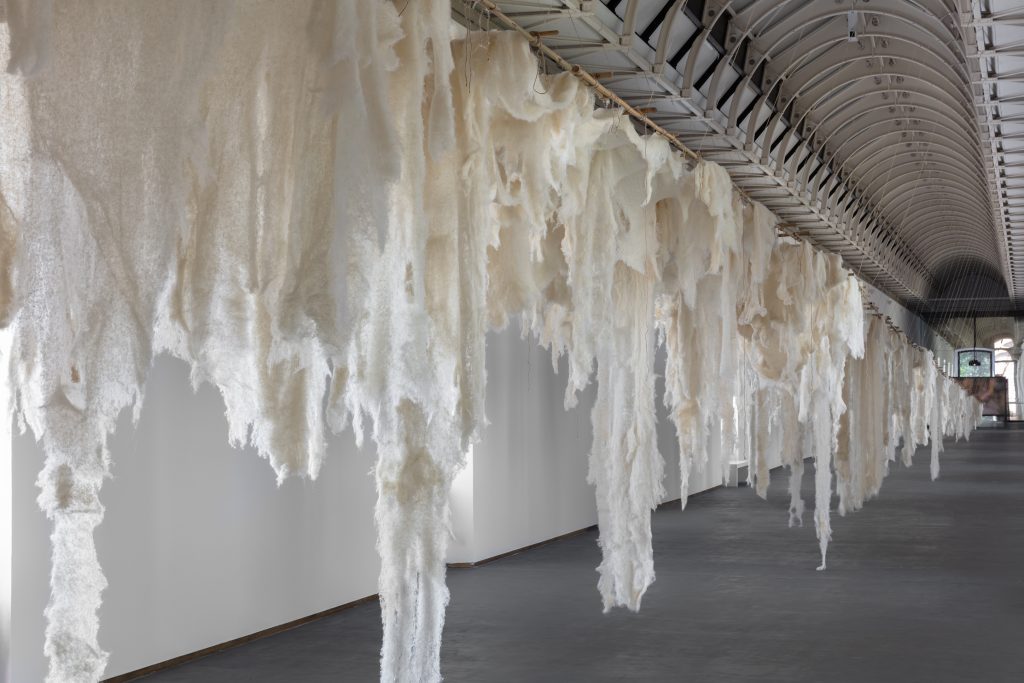
Cecilia Vicuña
El glaciar ido (The vanished glacier / Il ghiacciaio scomparso), 2026
Installation view
Castello di Rivoli Museo d’Arte Contemporanea, Rivoli-Torino
Photo Sebastiano Pellion di Persano
© CECILIA VICUÑA, by SIAE
Castello di Rivoli Museo d’Arte Contemporanea presents Cecilia Vicuña: El glaciar ido (The vanished glacier / Il ghiacciaio scomparso), the artist’s first solo exhibition in an Italian museum. Born in Santiago, Chile, in 1948 and now based in New York, Cecilia Vicuña is an artist, poet, and activist. Feminist and ecological, her work focuses on issues related to the defense of democracy, freedom of expression, and decolonial practices aimed at protecting the cultural heritage of Indigenous peoples. Performance, poetry, drawing, painting, video, and installations—ranging from minimal to monumental—make up her artistic universe. The concept of precarity informs Vicuña’s art, which, since the 1960s, has coined the term “Arte Precario” (Precarious Art). Promoting a terminology and practice free from colonial legacies, her work includes ephemeral and participatory projects, often made from small debris and found materials, in creative dialogue with the places and communities she encounters.
The exhibition at Castello consists of a new commission conceived by Vicuña for the Manica Lunga. Specifically designed for the building’s longitudinal spaces, the work is envisioned by the artist as a quipu acostado, a horizontal installation suspended at multiple heights. Belonging to ancient Andean civilizations and later widely used by the Incas, quipus (knots in the Quechua language) consist of knotted cords used as a system for recording information, including administrative, astronomical, and historical-narrative data. By directly referencing this type of artifact, Vicuña’s contemporary quipus become immersive environmental installations that traverse space and time. To create them, the artist favors raw, unprocessed wool, which she unwinds and assembles, producing striking aerial architectures.
In the Manica Lunga of the Castello, the new quipu El glaciar ido (The vanished glacier / Il ghiacciaio scomparso) serves as an evocative presence of transience, of the passage of time, of the movement of natural elements such as ice, water, and wind, and of the impact of the human presence in relation to the environment. The participatory nature of the quipuis a fundamental element that allows the work to become a “weaver” of people and places. The relationship with water is sought by Vicuña as a memory of the ancient glaciers, now extinct, that once dominated the landscape of the Valle di Susa, where the Castello is located.
The exhibition includes video works, bringing into the project images, sounds, and songs that have been an integral part of the artist’s practice since its beginnings. Acknowledging Vicuña’s role in the field of poetry, the exhibition features new poetic compositions written specifically by the artist and presented as “wall poems”. The exhibition will be accompanied by a new publication, the first focused on Vicuña’s long-standing research on glaciers.
“Unlike ancient quipus–states Marcella Beccaria, curator of the exhibition–Cecilia Vicuña’s contemporary quipu for Castello di Rivoli has no knots, alluding to the gradual loss of memory and care toward the world that hosts us. The project looks at what is disappearing or has already disappeared, also referring to the desaparecidos—victims of the Chilean dictatorship—and to the multitude of those who have been silenced or eliminated by repressive governments.”
This exhibition marks an important return for Vicuña to the Castello, the institution that first presented her work in Italy in 2000 as part of the group exhibition Quotidiana.
The process of preparing the exhibition involved a collective initiative that engaged local communities in walks and the gathering of small pieces of debris from the shores of nearby waterways and bodies of water, including the Dora Riparia and the Avigliana Lakes. Through a workshop organised in collaboration with the Accademia Albertina di Belle Arti in Turin, these materials were transformed into an ephemeral outdoor installation, which the artist entrusted to the creativity of a group of students.
Thanks to the Friend Benefactor Andrea Zegna for the support
With thanks to: Città di Rivoli, Città di Avigliana, Ente di gestione delle aree protette delle Alpi Cozie, Accademia Albertina di Belle Arti in Turin.
Partner

Trenitalia is the Official Green Carrier of Cecilia Vicuña’s exhibition – “El glaciar ido (The vanished glacier / The vanished glacier)”

No posts found.