Pluriversal Recapturings
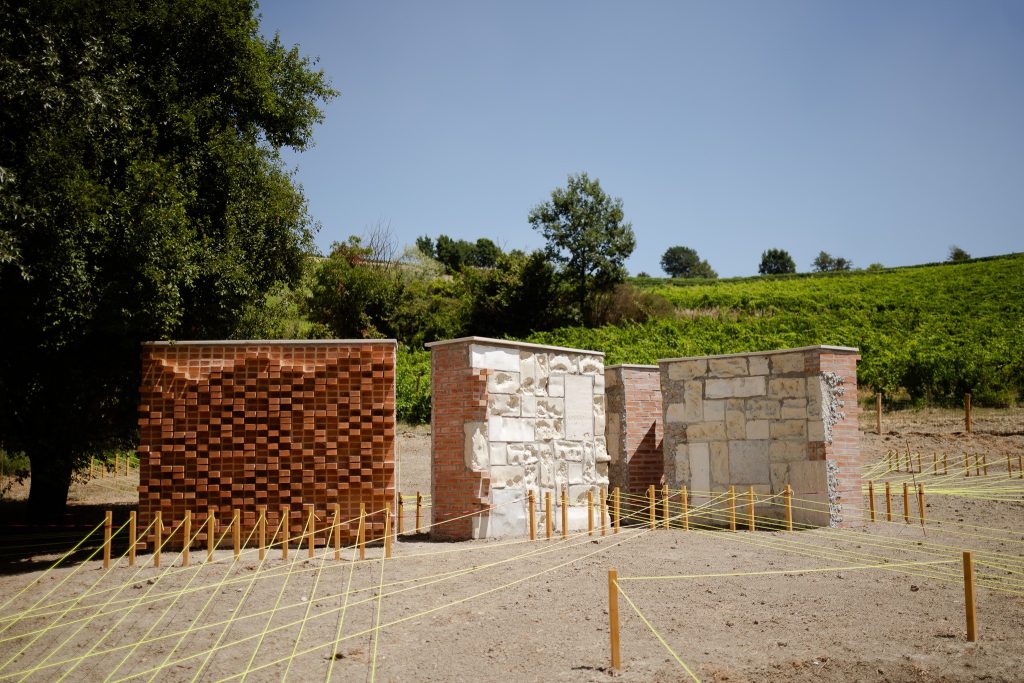
Maria Thereza Alves
Pluriversal Recapturings (Riconquiste pluriversali), 2026
Creative producer Elisa Strinna
Landscape design developed in collaboration with ecoLogicStudio
Commissioned by Castello di Rivoli Museo d’Arte Contemporanea
Financed by Regione Piemonte and Ministero del Turismo for the Municipality of Canelli in celebration of Sito UNESCO Paesaggi Vitivinicoli del Piemonte: Langhe-Roero e Monferrato
Photo Alberto Nidola
Courtesy Castello di Rivoli Museo d’Arte Contemporanea, Rivoli-Torino
The project celebrates the tenth anniversary of the UNESCO designation of Paesaggi Vitivinicoli di Langhe-Roero e Monferrato.
The project will be open to the public from 12 July.
The Municipality of Canelli, Castello di Rivoli Museo d’Arte Contemporanea, and Associazione per i Paesaggi Vitivinicoli di Langhe-Roero e Monferrato present Pluriversal Recapturings, 2026, a new public art project created by artist Maria Thereza Alves for the town of Canelli on the occasion of the tenth anniversary of the inscription of Paesaggi Vitivinicoli di Langhe-Roero e Monferrato on the UNESCO World Heritage List.
The project has been made possible through the support of Fondo Unico Nazionale per il Turismo (FUNT), established by the Italian Ministry of Tourism, and Regione Piemonte, with the curatorial coordination of Castello di Rivoli Museo d’Arte Contemporanea. Thanks to this initiative, the Municipality of Canelli has been included among “Capitali Sorelle” of Alba Capitale dell’Arte Contemporanea 2027.
Conceived specifically for the site of La Moncalvina in Canelli, the work emerges from the encounter between Maria Thereza Alves’s research and one of Europe’s most significant cultural landscapes, recognised by UNESCO as an outstanding example of the interaction between human activity and the natural environment.
One of the most respected Brazilian artists on the international contemporary art scene addressing political ecology, memory, and the relationships between human beings and the environment, Maria Thereza Alves has developed a multidisciplinary practice since the 1980s, intertwining art, activism, territorial research, and engagement with local communities. Through her work, the artist proposes new ways of representing the relationships between living species, territories, and ecological systems, questioning how environmental and social transformations influence the balance between human presence and the natural world.
Her research takes shape through careful observation of the geographical, ecological, and cultural contexts in which she works, with the aim of creating projects capable of fostering new awareness of the relationship between landscape, memory, and coexistence. Over the years, Alves has developed major international projects dedicated to the circulation of plant species, the effects of colonisation on territories, and the need to recognise more balanced forms of coexistence between human and non-human communities.
For the project developed in Canelli, Maria Thereza Alves undertook research in collaboration with professionals, university scholars, and local communities within Paesaggi Vitivinicoli di Langhe-Roero and Monferrato, exploring the long-standing relationships between territory, flora, fauna, and agricultural practices.
This investigation led to the development of Pluriversal Recapturings, a site-specific intervention comprising a wall structure, partly built of bricks and partly of “pietra da cantoni”, punctuated by inserts of different stones and designed to meet the habitat and microclimatic needs of a variety of local animal and plant species.
The work invites to reflect on the coexistence of the different forms of life inhabiting the territory and on the landscape intended as a dynamic system of relationships shaped by historical, cultural, and ecological stratifications. In this sense, the project proposes a vision of the UNESCO heritage not as a static image to be preserved, but as a living organism and a shared space in continuous transformation.
The intervention is situated within a broader ecological landscape design developed in collaboration with ecoLogicStudio, involving the planting of native species according to a concentric circular geometry intended to foster biodiversity and interspecies relationships. Conceived as an open and non-finalised system, the garden will evolve over time in response to the site’s microclimatic conditions, gradually allowing vegetation greater autonomy and enabling natural processes of transformation to unfold.
The project represents an important opportunity for dialogue between contemporary art, landscape, and cultural heritage, and forms part of the initiatives marking the UNESCO anniversary. It offers a reflection on landscape as a collective construction and living organism, shaped by historical stratifications, ecological relationships, and constantly evolving cultural practices.
Through this collaboration, Regione Piemonte, the Municipality of Canelli, Associazione per i Paesaggi Vitivinicoli di Langhe-Roero e Monferrato, and Castello di Rivoli Museo d’Arte Contemporanea reaffirm their shared commitment to promoting innovative forms of territorial enhancement through contemporary culture, bringing local realities into dialogue with international artistic research. In this context, the work is part of “Orma – Tracce d’artista in Langhe Monferrato Roero”, the network created by Ente Turismo Langhe Monferrato Roero, which connects artistic projects and territories while building a shared narrative of contemporary culture.
The work thus becomes part of Canelli’s public space as a permanent marker of the UNESCO anniversary and as an invitation to view the landscape not merely as a heritage to be preserved, but as a living, open, and evolving ecosystem.
Biography
Maria Thereza Alves (São Paulo, Brazil, 1961) has worked and exhibited internationally since the 1980s, creating a body of work investigating the histories and circumstances of particular localities to give witness to silenced histories. Her projects are researched-based and develop out of her interactions with the physical and social environments of the places she lives, or visits for exhibitions and residencies. These projects begin in response to local needs and proceed through a process of dialogue that is often facilitated between material and environmental realities and social circumstances. While aware of Western binaries between nature and culture, art and politics, or art and daily life, she deliberately refuses to acknowledge them in her practice. She chooses instead to work with people in communities as equals through relational practices of collaboration that require constant movement across all of these boundaries.
Alves has participated in the Helsinki Biennial (2025); Lagos Biennial (2024); Thailand Biennale, Chiang Rai (2023); Art and Urban Nature Biennal, Geneva (2023); documenta fifteen, Kassel (2022); Panamerican Biennial of Quito (2021); Ural Biennial, Ekaterinburg (2021); Biennale of Sydney (2020); Toronto Biennial (2019); Manifesta 12, Palermo (2018); Frestas Triennale, Sorocaba, Brazil (2017); Sharjah Biennal (2017); Bienal de São Paulo (2016, 2010); Berlin Biennale (2014); dOCUMENTA (13), Kassel (2012); Taipei Biennial (2012); Lyon Biennale (2009); Guangzhou Triennial (2008); Manifesta 7, Trento (2008); and Havana Biennial (1986) among others.
Alves is the recipient of the Vera List Prize for Art and Politics 2016-2018. In 2024 she received the “Napoli è Donna” – Lydia Cottone Award – Art Category.
With the support of

Landscape design developed in collaboration with ecoLogicStudio.