Dennis Oppenheim
Over the course of his career, Dennis Oppenheim has engaged and often defined some of the most important art movements of the last thirty years.
His early work addressed the urban and natural landscapes. Drawn to the new sense of space offered by the natural environment and by the ephemeral character of actions effected in it, Oppenheim helped to define the then nascent Earth Art movement. Time Line, 1968, belongs to this period. The work has its origins in an action developed in Maine, where the St. John River marks the border between the United States and Canada, and also marks the International Date Line. Cutting a line in the frozen river, the artist created a sort of physical transcription of the political boundary that runs along the river, rendering physically visible information that otherwise would remain abstract. Photographs, an aerial map, and a short text document the work.
The power of this relationship with the natural environment soon led Oppenheim to approach his own body as a field of resistance and energy, and he became one of the pioneers of Body Art. In addition to photography, the artist used film and video to document the birth and development of simple activities, often using a movie camera in a fixed position and allowing it to record in real time. Rocked Hand, 1970, is a sequence of three images taken from an 8-millimeter film that documents the action of one hand slowly covering the other with stones, so that it became weighted down and mimicks its rock-filled surroundings. With this action, the artist divides his body into two distinct parts, one active, the other passive. Beginning in the mid-1970s, the artist began to use marionettes in place of his own body.
In his more recent works Oppenheim has created installations of growing complexity, including mechanical parts and sometimes resorting to almost theatrical techniques.
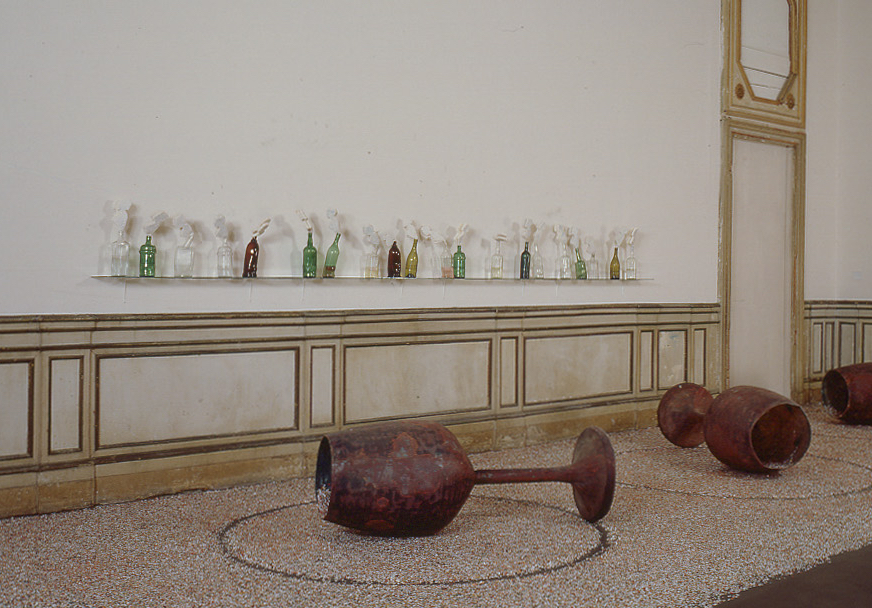
In Between Drinks, 1991, a thick carpet of confetti visually unites the forms of three large glasses overturned on the floor together with another work by Oppenheim, Double Headed Woman with Floating Hearts, 1991. The work, mounted on the wall, consists of a long shelf that holds a series of bottles, partly warped, as if seen through the befuddled eyes of someone who has imbibed their contents. Silhouettes of female figures in polystyrene emerge from the bottles, each of which contains within a small floating heart. Repetitive and fragmented like a hallucination, the installation refers in tragic tones to a weakened mental condition, portrayed behind an apparent theatrical playfulness.
A sense of anguished expectation emanates from Gathering, 1993, a work that brings together a row of figures crouching on the ground, above which there hangs an enlarged teaspoon brimming with white powder, a clear reference to the widespread destructive power of drugs. The artist’s black humor depicts the figures as a series of identical wax candles, complete with wicks and destined to burn, one after the other.
[M.B.]
Upon completing his studies at Stanford University in Palo Alto, California and after a visit to New York in 1966, Dennis Oppenheim decided to stop creating artistic objects. He moved to New York and up until 1969 he dedicated himself to making large-scale projects centered on interventions in natural settings. The artist engaged in the landscape or the transfer of landscape elements to a radically different space, such as the land works on the two snow-covered banks of the St. John River or the concentric circles imposed on the border between Canada and the United States.
Within a few years he produced a seires of open-air actions, key works of the first period of Land Art, and, almost concurrently, developed a series of performances of intense physical involvement, attracting the attention of critics. A precise awareness of the potentials of his body, developed during the creation of numerous Land Art projects, led him to consider it as a malleable field of transformable resistance and energy.
Among the first artists to employ film and video as a means not only of documenting but also of investigating and testing his own physical and psychological limits, Oppenheim, in a vast series of experiments conducted mainly between 1970 and 1974, used his body as a site for challenging limits. Through the transformation and manipulation of materials with his own body, he created performative actions possessing an intense ritualistic component. Using natural elements taken from the environment—such as plants or stones—he developed physical forms of relationships between his own forces and these objects, or directly on the natural environment itself. In his films and videos, the actions are developed in real time. In some exceptional cases, the artist also intervenes in the works’ post-production. [F.B.]
List of Works
Program One: Aspen Projects, 1970
video, black and white, color, silent, 30 min. 15 sec.
Castello di Rivoli Museum of Contemporary Art, Rivoli-Turin
Material Interchange, 1970
transferred from 16 mm film, black and white, silent, 2 min. 44 sec.
A close-up of the artist’s nail rubbing against a wooden surface.
Identity Transfer, 1970
transferred from 8 mm film, black and white, silent, 1 min.
The artist records the pressure between a thumb, an index finger, and finger nails, which in turn leave a sign on the skin.
Rocked Hand, 1970
transferred from 8 mm film, color, silent, 3 min. 34 sec.
One hand is slowly covered with stones by the other hand.
Compression – Fern (Hand), 1970
transferred from 16 mm film, color, silent, 5 min. 46 sec.
A fern is slowly crushed inside the hand that holds it.
Pressure Piece #1, 1970
transferred from 8 mm film, color, silent, 1 min. 40 sec.
The fingers of a hand produce pressure and mark the surface of a mirror covered with condensation.
Glassed Hand, 1970
transferred from 16 mm film, color, silent, 2 min. 56 sec.
A hand is slowly covered with small glass splinters.
Compression – Poison Oak, 1970
transferred from 16 mm film, silent, 2 min. 46 sec.
Analogous to the fern, a red oak flower is slowly crushed in the hand that holds it.
Compression – Fern (Face), 1970
transferred from 16 mm film, color, silent, 5 min. 22 sec.
Hidden behind a fern he holds, the artist progressively crushes the entire plant in his hands.
Leafed Hand, 1970
transferred from 16 mm film, color, silent, 3 min. 44 sec.
A hand is progressively and entirely covered with dry leaves.
Program Two, 1970
transferred from Super 8 and 16 mm film, color, silent, 15 min. 08 sec.
Castello di Rivoli Museum of Contemporary Art, Rivoli-Turin
Extended Armor, 1970
transferred from Super 8 film, black and white, silent, 2 min. 08 sec.
In a fixed shot, the artist pulls out some hair, makes a ball with it, and then uses it to inhibit the movements of a tarantula inside a narrow wooden container.
Gingerbread Man, 1970
transferred from 8 mm film, black and white, silent, 1 min. 42 sec.
The artist spreads molasses on his teeth and proceeds to eat a gingerbread man.
Nail Sharpening, 1970
Transferred from 16 mm film, black and white, silent, 2 min. 57 sec.
A close-up of a toenail sharpened by a stone.
Toward Becoming a Devil, 1970
transferred from 16 mm film, black and white, silent, 2 min. 20 sec.
The artist methodically sleeks his hair onto his forehead, hiding his face.
Rocked Stomach, 1970
transferred from 16 mm film, color, silent, 2 min. 48 sec.
Stones placed on the artist’s stomach are moved with muscular contractions.
Fusion: Tooth and Nail, 1970
transferred from Super 8 film, color, silent, 2 min. 58 sec.
Oppenheim brings his fingernails to his teeth and paints them with red nail polish.
Program Three, 1972–1974
transferred from 16 mm film, black and white, color, sound, 24 min. 30 sec.
Castello di Rivoli Museum of Contemporary Art, Rivoli-Turin
Brush, 1973
transferred from 16 mm film, color, sound, 4 min. 56 sec.
An extreme close-up of a brush placed on a spinning long-playing record playing soul music.
I’m Failing, 1972–1973
transferred from 16 mm film, color, sound, 1 min. 48 sec.
A series of close-ups of air bubbles emitted by the mouth of the artist who is under water. The view is fuzzed by the same bubbles he produces.
My Father’s Socks, 1972
transferred from 16 mm film, black and white, sound, 5 min. 50 sec.
The artist’s legs are shown in extreme close-up as he methodically puts on a series of socks, one after the other.
Mittens, 1974
transferred from 16 mm film, black and white, sound, 4 min. 21 sec.
A little girl is engaged in a struggle with her gloves as though they provoke the continuous movement of her arms.
Disappear, 1972
transferred from 16 mm film, black and white, sound, 5 min. 57 sec.
A continuous shot of a right hand frenetically moving challenges the possibility of recording the action.
Program Four, 1971–1972
video, black and white, silent, 44 min. 50 sec.
Castello di Rivoli Museum of Contemporary Art, Rivoli-Turin
Vibration #1, 1971
video, black and white, silent, 13 min. 30 sec.
A lengthy shot from above a membrane that is made to vibrate by the percussive action of two hands in such a way as to progressively move dust.
Vibration #2, 1972
video, black and white, silent, 11 min. 24 sec.
With the shadow of his hand the artist mimes the gesture of destroying a pile of sand that, in reality, is flattened by concomitant vibrations.
2 Stage Transfer Drawing (Advancing to a Future State), 1971
video, black and white, silent, 7 min, 42 sec.
Erik, the artist’s son, traces out a drawing on his father’s back who in turn tries to duplicate the drawing on a wall.
2 Stage Transfer Drawing (Returning to a Past State), 1971
video, black and white, silent, 12 min. 04 sec.
With regards to the previous exercise, the roles are reversed and the artist draws on his son’s back who in turn tries to reproduce the same drawing on a sheet of paper.
Program Five, 1970–1971
video and transferred from 8 mm film, black and white, color, silent, 37 min. 45 sec.
Castello di Rivoli Museum of Contemporary Art, Rivoli-Turin
Air Pressure (Hand), 1971
video, color, silent, 5 min. 25 sec.
Two close-up shots show the results of strong air pressure, first on the back and then on the palm of a hand.
Lead Sink for Sebastian, 1970
video, color, silent, 4 min. 42 sec.
The video shoots a performance in San Francisco. The protagonist is a man with an amputated leg. The missing limb is substituted with a lead prosthesis that, due to the heat of a torch, gradually melts.
Nail Sharpening, 1970
video, color, silent, 6 min. 02 sec.
A new color version of the unusual, previously recorded sculptural gesture.
Gingerbread Man, 1970–1971
transferred from Super 8 film, video, black and white, silent, 8 min. 45 sec.
The artist chews and then swallows a gingerbread man.
Fusion: Tooth and Nail, 1970
transferred from Super 8 film, video, color, silent, 12 min. 03 sec.
As in the previous version, Oppenheim brings the nails of a hand to his teeth, although this time he paints them with nail polish of different colors: silver, red, blue, and yellow.
Program Six, 1971–1972
video and transferred from Super 8 film, black and white, color, silent, 27 min. 18 sec.
Castello di Rivoli Museum of Contemporary Art, Rivoli-Turin
Forming Sounds, 1971
video, black and white, color, silent, 7 min. 14 sec.
In a close-up, a face is manipulated by two hands that alter vocal emissions.
2 Stage Transfer Drawing (Advancing to a Future State), 1971
transferred from Super 8 film, color, silent, 2 min. 48 sec.
A new color version of the drawing exercise previously recorded in black and white.
2 Stage Transfer Drawing (Returning to a Past State), 1971
transferred from Super 8 film, color, silent, 2 min. 57 sec.
A new color version of the drawing exercise previously recorded in black and white.
A Feedback Situation, 1971
transferred from Super 8 film, color, silent, 3 min. 02 sec.
Oppenheim and his son simultaneously draw on each other’s back without seeing the results.
3 Stage Transfer Drawing, 1972
transferred from Super 8 film, color, silent, 3 min. 07 sec.
The artist draws a series of shapes on the back of his daughter, Chandra, which the little girl then draws on the back of her brother who, in turn, tries to reproduce them on a sheet of paper placed in front of him.
2 Stage Transfer Drawing (Returning to a Past State), 1971
transferred from Super 8 film, color, silent, 3 min.
A further version of the drawing exercise carried out by father and son.
Objectified Counterforces, 1971
video, color, silent, 2 min. 06 sec.
Erik and Kristin Oppenheim have a sack race.
Shadow Project, 1971
video, color, silent, 3 min. 04 sec.
The hands of the artist rapidly produce a series of Chinese shadows on a wall.
Program Seven, 1968–1972
video, transferred from Super 8 film and from 35 mm slides, black and white, color, silent, 27 min. 19 sec.
Castello di Rivoli Museum of Contemporary Art, Rivoli-Turin
Feedback, 1971
video, black and white, silent, 1 min. 50 sec.
The artist mimes the letters of the alphabet on his daughter Kristin’s back.
Extended Expressions, 1971
video, black and white, silent, 5 min. 05 sec.
Oppenheim and his son Erik are shot in close-up, imitating each other by making faces.
Ground Gel, 1972
transferred from a 35 mm slide, color, silent, 6 min. 50 sec.
In a film composed of still-images, one dissolving into the next, a human figure spins a little girl round while holding her arms.
Air Pressure (Hand), 1972
video, black and white, silent, 6 min. 37 sec.
The results of strong air pressure are shown on a hand.
Landslide, 1968
transferred from Super 8 film, color, silent, 2 min. 55 sec.
The work consists in a sequence of shots of landslides filmed in Long Island.
Preliminary Test for 65° Vertical Penetration, 1970
transferred from Super 8 film, color, silent, 3 min. 37 sec.
In a series of shots, from a distance and in close-up, the artist lets himself slide down a landslip hill.
Arm Scratch, 1970
transferred from Super 8 film, color, silent, 1 min. 56 sec.
The focus is on the continuous image of a hand scratching an arm.
Identity Transfer, 1970
transferred from Super 8 film, black and white, silent, 4 min. 24 sec.
Two thumbs and thumbnails touch and rub each other, rotating and marking each other with black ink.
Program Eight, 1969–1972
Video, transferred from Super 8 film, black and white, color, silent, 28 min. 44 sec.
Castello di Rivoli Museum of Contemporary Art, Rivoli-Turin
Go-Between, 1972
video, black and white, silent, 6 min. 15 sec.
While seated, Oppenheim and his family touch each other and cross their arms and legs.
Stewing Around, 1972
video, black and white, silent, 3 min. 37 sec.
In a series of still images, the artist rotates a weight around himself.
Whipping into Shape, 1972
video, color, silent, 5 min. 35 sec.
With whip lashes the artist tries to give form to some objects and wooden rods placed on the ground.
Landslide #2, 1972
transferred from Super 8 film, black and white, silent, 6 min.
Further shots of stones rolling down a hill.
Parallel Arcs, 1970
transferred from Super 8 film, black and white, silent, 2 min. 35 sec.
Oppenheim progressively lets himself fall frontwards, dragging with him a young tree that is tied to his belt.
Broad Jump, 1969
transferred from Super 8 film, black and white, silent, 2 min. 20 sec.
Fixed framing records the artist jumping over a line.
Slow Punch, 1970
transferred from Super 8 film, black and white, silent, 1 min. 02 sec.
A slowed sequence of punches to a stomach.
Rocks in Navel, 1970
transferred from Super 8 film, black and white, silent, 2 min.
A series of close-ups of small pebbles placed on a bare navel.