Gilberto Zorio

  • art works
  • work
  • biography
  • bibliography
  • exhibitions
    • Macchia III (Stain III)

      Macchia III (Stain III)

      1968

      black rubber, rope

      rubber, 47 1/4 x 49 5/8 x 2 3/4 in.

      rope, variable dimensions

      Collection Margherita Stein

      Property Fondazione CRT Project for Modern and Contemporary Art, 2001

      Permanent loan

      Castello di Rivoli Musum of Contemporary Art, Rivoli-Turin

      GAM -  Municipal Gallery of Modern and Contemporary Art, Turin

    • Tenda (Tent)

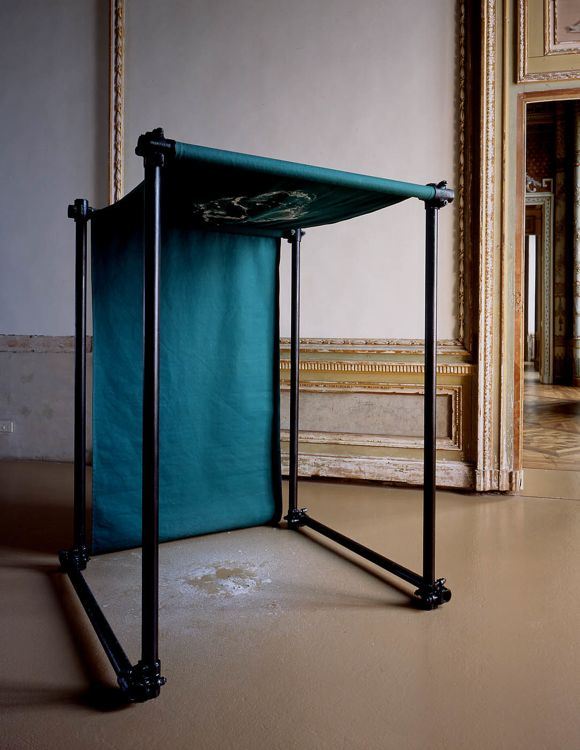
      Tenda (Tent)

      1967

      iron tubes, clamps, green cotton canvas, seawater

      66 15/16 x 51 9/16 x 49 3/16 in.

      Collection Margherita Stein

      Property Fondazione CRT Project for Modern and Contemporary Art, 2001

      Permanent loan                                                                                

      Castello di Rivoli Musum of Contemporary Art, Rivoli-Turin

      GAM -  Municipal Gallery of Modern and Contemporary Art, Turin

    • Barca nuragica (Nuraghic Boat)

      Barca nuragica (Nuraghic Boat)

      2000

      woven reeds, compressor,  aluminum, lamp, sound

      177 3/16 x 236 1/4 x 251 15/16 in.

      Castello di Rivoli Museum of Contemporary Art, 2001

    • Colonna (Column)

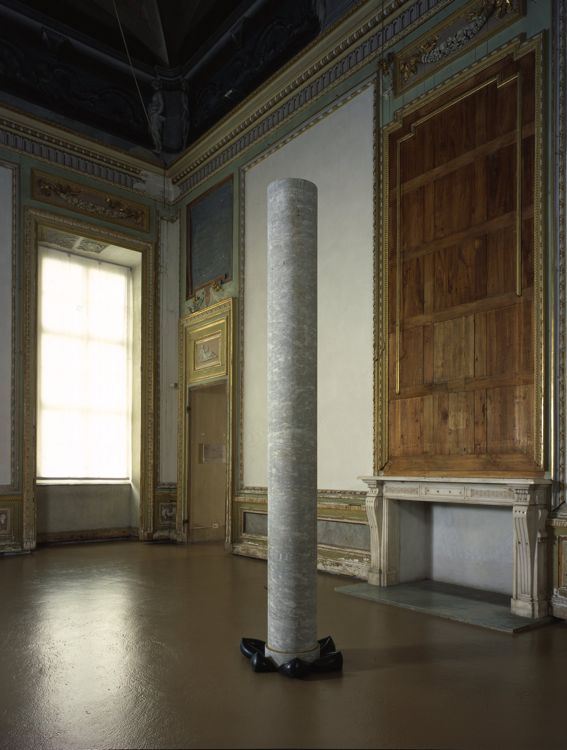
      Colonna (Column)

      1967

      Eternit tube, inner-tire tubes

      118 1/8 x 11 13/16 in. (diameter)

      Collection Margherita Stein

      Property Fondazione CRT Project for Modern and Contemporary Art, 2001

      Permanent loan

      Castello di Rivoli Musum of Contemporary Art, Rivoli-Turin

      GAM -  Municipal Gallery of Modern and Contemporary Art, Turin

  • Gilberto Zorio’s works are unending fields of physical and mental energy. One of the leading figures of the Arte Povera group, since 1966 Zorio has directed his investigations toward the processes issues that make each work continually mutable. Setting up chemical or physical reactions, the artist enters his works into a life cycle in which he is present as a spectator. Time is often an important component, in that only the natural passage of hours and days makes fully tangible the transformations to which the works are subjected.
    In Tenda (Tent), 1967, the evaporation of seawater and the resulting traces in the form of salt crystals delineate the dynamic of a natural landscape. The salt lake that forms at the viewer’s eye level corresponds to the anthropocentric dimension that Zorio celebrates in his works. Even the installation’s metal tubes on which a cloth rests are conceived by the artist as within a human dimension, and he compares their function to that of the veins and skeleton in a body.
    Zorio renews the language of sculpture, freeing it from the fixity and heaviness with which it has traditionally been associated. In Colonna (Column), 1967, a tube of heavy asbestos cement rests on an inner-tire tube, almost as if it were an overturned column. The tube thus remains in precarious equilibrium, and its weight causes the inner tube to harden and the rubber to lose its flexibility. The juxtaposition of the two materials erodes the apparent nature of each, suggesting the image of a rising architecture.
    The idea of ascent is also present in Macchia III (Stain III), 1968. Zorio has stated: “I have always been interested in an attempt to raise up sculpture, to suspend it and place it in the air, in order to occupy the entire space, including the aerial horizon.” The work is created by scattering liquid rubber on the ground, in concentric circles. Subsequently the rubber is suspended in the space by cords whose tension is never definitive. The elevation of the sculpture corresponds to the artist’s attempt to make tangible the way the work belongs to the space of the imagination, continually renewing the wonder of an unexpected encounter.
    The narrative dimension is often present in Zorio’s works, in the form of a fantastical story that traverses time and space. Thus elements such as crucibles, javelins, goatskins, and especially canoes appear as elements in his work, used as instruments of a possible voyage. Barca nuragica (Nuraghic Boat), 2000, is a section of a canoe made from interwoven rushes, presented as a vector that has traveled through history and different civilizations. Dynamically triangular, the work effects movements that seem like the beginnings of a new journey. Hoisted up in the space, it is also freed by the usual silence of sculpture and restored to life as a result of the whistling emitted by the compressed air that causes its movement.

    [M.B.]

    • Arte Povera International

      Arte Povera International

      curated by Germano Celant and Beatrice Merz From 9 October, 2011, the Castello di Rivoli will be presenting its own contribution to Germano Celant’s ambitious curatorial project: Arte Povera 2011. The exhibition at the Castello di Rivoli, Arte Povera International,…

    • Everything is connected. Research and investigations into art of the past decade through the collection

      Everything is connected. Research and investigations into art of the past decade through the collection

      curated by Beatrice Merz tutto è connesso, the exhibition on the first and second floors of Castello di Rivoli, was conceived as a way of establishing a critical presentation based on works in the permanent collection, which will then result…

    • From the Earth to the Moon: Metaphors for Travel (Part I)

      From the Earth to the Moon: Metaphors for Travel (Part I)

      Curated by Marcella Beccaria    A force that can alter the course of history, the voyage constitutes a richly symbolic territory, capable of assuming many forms and bringing together multiple meanings. From nomadism to migrations, from mythological adventures to pilgrimages,…

    • Arte Povera in the collection

      Arte Povera in the collection

      Curated by Ida Gianelli, Marcella Beccaria, Giorgio Verzotti   Arte Povera, which developed during the second half of the ‘Sixties simultaneous to analogous international movements such as Process Art and Conceptual Art, proposed an artistic working methodology that, establishing a…

    • Collezionismo a Torino (collecting in Turin)

      Collezionismo a Torino (collecting in Turin)

      This exhibition illustrates the importance of private collecting in Italy, which is sometimes shrewder and more astute than its public counterpart in discovering ever-new contributions to the development of contemporary art history. The public is presented with a selection of…

    • L’orizzonte (THE HORIZON)

      L’orizzonte (THE HORIZON)

      Curated by Rudi Fuchs, Ida Gianelli   The permanent collection for a museum is what defines it and qualifies its identity, and it constitutes a patrimony that can be used by the community, encouraging familiarity with art and the directions…

    • Un’avventura internazionale. Torino e le arti 1950-1970 (AN INTERNATIONAL ADVENTURE. TURIN AND THE ARTS 1950 – 1970)

      Un’avventura internazionale. Torino e le arti 1950-1970 (AN INTERNATIONAL ADVENTURE. TURIN AND THE ARTS 1950 – 1970)

      Curated by Germano Celant, Paolo Fossati, Ida Gianelli   The scope of this exhibition was to highlight the crucial part played by the city of Turin between 1950 and 1970 in the development of the visual arts and contemporary culture….

    • Ouverture II

      Ouverture II

      Curated by Rudi Fuchs and Johannes Gachnang The objective of “Ouverture II” was to explore further the concepts initially examined in the Castello di Rivoli’s inaugural exhibition of the same name. The Castello reiterated its primary aim, to create the…

    • Ouverture

      Ouverture

      The Castello di Rivoli’s first exhibition was conceived as a blueprint for the permanent collection, focusing on pivotal moments in contemporary art. The aim was to provide a broad, inclusive survey of living artists, many of whom were invited by…