Giuseppe Penone

  • art works
  • work
  • biography
  • bibliography
  • exhibitions
    • Pelle di foglie (Sguardo a terra) (Skin of Leaves – Downward Glance)

      Pelle di foglie (Sguardo a terra) (Skin of Leaves – Downward Glance)

      2003

      bronze

      118 1/8 x 90 9/16 x 39 3/8 in.

      Castello di Rivoli Museo d’Arte Contemporanea

      Permanent loan

      Fondazione CRT Progetto Arte Moderna e Contemporanea, 2005

    • Respirare l’ombra (Breathing the Shadow)

      Respirare l’ombra (Breathing the Shadow)

      1999

      wire mesh, laurel leaves, bronze

      216 15/16 x 489 3/8 x 370 1/16 in.

      Castello di Rivoli Museo d’Arte Contemporanea

      Permanent loan

      Fondazione CRT Progetto Arte Moderna e Contemporanea , 2005

    • Albero di 11 metri (11-meter Tree)

      Albero di 11 metri (11-meter Tree)

      1969–89

      spruce wood

      2 elements, 203 1/8 x 17 11/16 x 17 11/16 in. each

      Castello di Rivoli Museo d’Arte Contemporanea, 1996

    • Soffio di creta H (Clay Breath H)

      Soffio di creta H (Clay Breath H)

      1978

      terra-cotta

      63 x 31 1/2 x 31 1/2 in.

      Castello di Rivoli Museo d’Arte Contemporanea

      Long-term loan – Fondazione Marco Rivetti, 2000

    • Albero di 5 metri (5-meter Tree)

      Albero di 5 metri (5-meter Tree)

      1969–70

      spruce wood

      194 1/2 x 7 11/16 x 3 15/16 in.

      Collection Margherita Stein

      Property Fondazione CRT Progetto Arte Moderna e Contemporanea, 2001

      Permanent loan

      Castello di Rivoli Museo d’Arte Contemporanea, Rivoli-Torino

      GAM – Galleria Civica d’Arte Moderna e Contemporanea, Torino

  • Giuseppe Penone ’s exploration of the interaction between cultured and natural forms is central to his art. Believing that a common fluidity unites man and nature, in a continuous state of exchange and symbiosis, Penone interweaves an intense and complex discourse that analyzes reality and material.
    Starting with personal reflections tied to the cultural context in which he was raised and to the historical moment in which he began working as a sculptor, the artist translates his connection to the earth and the landscape into his own artistic vocabulary. The image of the tree and the body have always been the supporting structure of his artistic enterprise, and he directs the content of his investigations both toward nature, with the intention of visualizing and modifying the processes of natural growth, and toward the body, a constant subject for his work. His art examines mechanisms linked to transformation and investigates the sensual dimension of materials, asserting an intention to construct an evolutive continuity with the artistic references of classical sculpture.
    Albero di 5 metri (5-meter Tree),1969 –70,and Albero di 11 metri (11-meter Tree),1969 –89,belong to a cycle of works called Alberi (Trees),which the artist worked on from 1969 until recently. Beginning with industrial wooden beams, he carves, scores,and “excavates ” the wood, to bring out the original tree ’s trunk and branches, which he identifies through the knots that are still visible in the beam.
    With a process the artist has defined as “barking ” (the removal of the bark),he extracts the form of a younger tree, whose image is still preserved within the beam. These works attest to his interest in the process phase of the work, and while conceived as autonomous and independent forms, they are the result of cohesive examination of the regeneration of the forest, as seen in a large installation he created for the Stedelijk Museum in Amsterdam, in 1980.
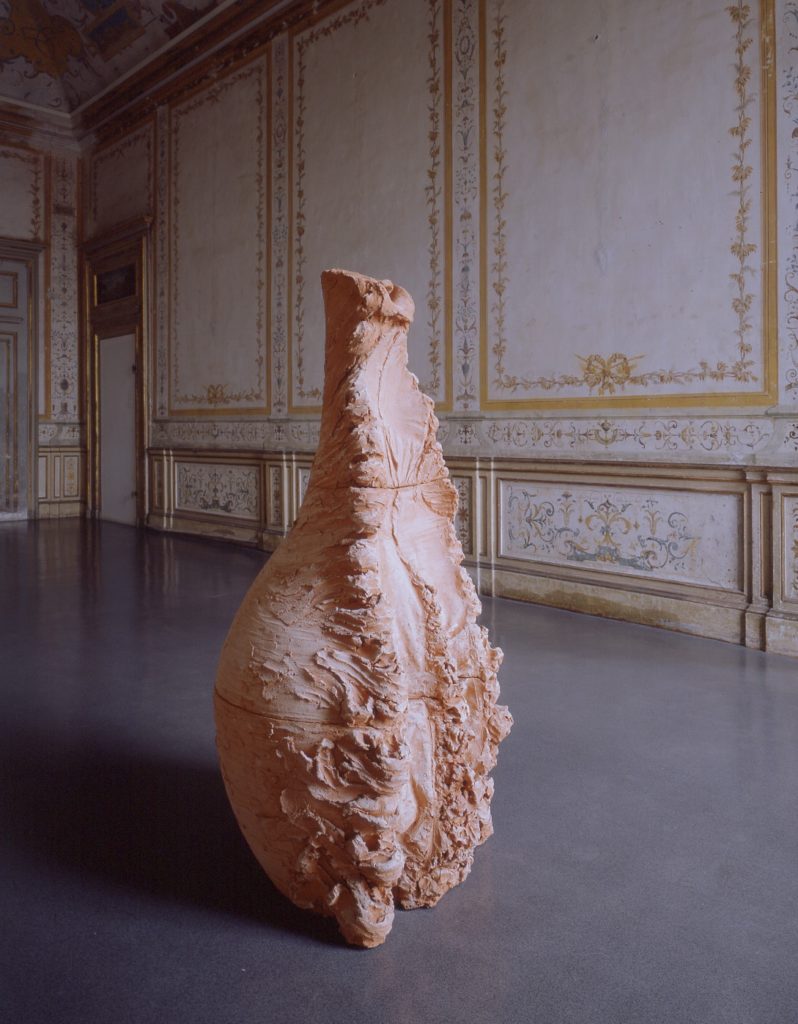
    In Soffi (Breaths)a series created beginning in 1978, Penone taps into the world of mythology for the image of breath as the origin of man and a vital and energetic element. Mindful of classical philosophical musings, in Soffio di creta H (Clay Breath H),1978,he attempts to give solidity to the immaterial, reproducing the volume of his own breath, which takes on physical consistency and assumes the form of a vase imprinted with the mark of his body, shaped into the clay. It is a work that analyzes the act of exhaling, in which air, expelled from the lungs, becomes form upon contact with the atmosphere. It is a way of creating an invisible sculpture that accompanies us day after day, throughout our lives.
    Respirare l ’ombra (Breathing the Shadow),1999,belongs to a group of more recent works in which, using large-scale installations, Penone develops visual and sensory paths into his expressive world. Even though separated by more than twenty years, this work can be seen as thematically complementary to the Soffi .If in the Soffi he investigates and penetrates the moment of exhalation, in this sculpture the artist focuses on the moment when we breathe in. The work is presented as an environment covered in bay leaves, with a bronze lung visible at the center of one of the walls. Combining the intense od or of the leaves with the idea of breathing, the artist not only defines the boundaries of the space and the shape of the place, but also confirms that the artist ’s interest is not directed toward representation, but rather toward the evocation and suggestion of a poetic image.
    Pelle di foglie (Sguardo a terra )(Skin of Leaves – Downward Glance),2003,also fits into Penone ’s continuous investigation of surfaces, the sensitivity of the skin, and the relationship between the natural and human worlds. Here, references to nature and a comparison with the poetic content of its forms explore the primary relationship with the material, evoking its mythical aspects. The image of an arboreal figure, which extends into the space, is the emanation of a memory tied to the classics of our culture, in which mythology is never a direct source, but rather a suggestion, an impression that encounters an echo and a foundation in the celebration of nature, in empathy with the natural world. The sensuality of this sculptural form finds correspondence in the medium employed —bronze —the quintessential metal used in classical sculpture. Penone, who has always been open to the use of vast range of materials, has a particular predilection for bronze, a metal which, through its metamorphic properties, summarizes the artist ’s aesthetics and allows his feeling for the infinite fluidity of matter to emerge.

    [G.C.]

  • Giuseppe Penone. L’image du toucher, Fonds Regionals d’Art Contemporain de Picardie, 1994.

    Giuseppe Penone, Die Adern des Steins, Kunstmuseum, Bonn – Cantz, Stoccarda, 1997.

    Giuseppe Penone, Carré d’Art – Musée d’art contemporain, Nîmes – Hopefulmonster, Torino, 1997.

    Giuseppe Penone 1968-1998, Centro Galego de Arte Contemporáneo, Santiago de Compostela, 1999.

    G. Penone, Respirer l’ombre, École national supérieure des Beaux-Arts, Parigi, 2000

    • Arte Povera International

      Arte Povera International

      curated by Germano Celant and Beatrice Merz From 9 October, 2011, the Castello di Rivoli will be presenting its own contribution to Germano Celant’s ambitious curatorial project: Arte Povera 2011. The exhibition at the Castello di Rivoli, Arte Povera International,…

    • Everything is connected 2

      Everything is connected 2

      curated by Beatrice Merz Castello di Rivoli presents tutto è connesso 2, a new installation of the permanent collection, in continuity with the broader redefinition of the spaces that were set aside for the previous tutto è connesso show. The…

    • Exhibition | Exhibition

      Exhibition | Exhibition

      curated by Adam Carr EXHIBITION, EXHIBITION is an exhibition that sets out to explore and reflect on the roles of perception and interpretation in the experience of viewing both works of art and art exhibitions, revising the ways in which…

    • Everything is connected. Research and investigations into art of the past decade through the collection

      Everything is connected. Research and investigations into art of the past decade through the collection

      curated by Beatrice Merz tutto è connesso, the exhibition on the first and second floors of Castello di Rivoli, was conceived as a way of establishing a critical presentation based on works in the permanent collection, which will then result…

    • A Room of One’s Own

      A Room of One’s Own

      Curated by Marcella Beccaria Taking its inspiration from Virginia Woolf’s homonymous essay (1929), the exhibition A Room of One’s Own is a reflection on the positive value of solitude and its importance in the creative realm. Immersing viewers in spaces…

    • Arte Povera in the collection

      Arte Povera in the collection

      Curated by Ida Gianelli, Marcella Beccaria, Giorgio Verzotti   Arte Povera, which developed during the second half of the ‘Sixties simultaneous to analogous international movements such as Process Art and Conceptual Art, proposed an artistic working methodology that, establishing a…

    • Collezionismo a Torino (collecting in Turin)

      Collezionismo a Torino (collecting in Turin)

      This exhibition illustrates the importance of private collecting in Italy, which is sometimes shrewder and more astute than its public counterpart in discovering ever-new contributions to the development of contemporary art history. The public is presented with a selection of…

    • L’orizzonte (THE HORIZON)

      L’orizzonte (THE HORIZON)

      Curated by Rudi Fuchs, Ida Gianelli   The permanent collection for a museum is what defines it and qualifies its identity, and it constitutes a patrimony that can be used by the community, encouraging familiarity with art and the directions…

    • Un’avventura internazionale. Torino e le arti 1950-1970 (AN INTERNATIONAL ADVENTURE. TURIN AND THE ARTS 1950 – 1970)

      Un’avventura internazionale. Torino e le arti 1950-1970 (AN INTERNATIONAL ADVENTURE. TURIN AND THE ARTS 1950 – 1970)

      Curated by Germano Celant, Paolo Fossati, Ida Gianelli   The scope of this exhibition was to highlight the crucial part played by the city of Turin between 1950 and 1970 in the development of the visual arts and contemporary culture….

    • Giuseppe Penone

      Giuseppe Penone

      Curated by Ida Gianelli and Giorgio Verzotti   The entire body of work produced by Giuseppe Penone (Garessio, Cuneo, Italy, 1947) investigates nature and its many evolving forms. He works in direct contact with the natural environment, attempting to visualise…

    • Standing Sculpture

      Standing Sculpture

      Curated by Rudi Fuchs, Johannes Gachnang and Francesco Poli   During the 20th century, sculpture – like the other traditional art forms – underwent changes so profound that its very status was brought into question. This loss of identity led…

    • Ouverture

      Ouverture

      The Castello di Rivoli’s first exhibition was conceived as a blueprint for the permanent collection, focusing on pivotal moments in contemporary art. The aim was to provide a broad, inclusive survey of living artists, many of whom were invited by…