Grazia Toderi 2019
Conversation about earth
Grazia Toderi and Marco Toderi
Grazia Toderi: Marco, you’re my brother and, like our father, you’re an agronomist.
We live a long way from each other and it’s only in the summer that we get a chance to spend a few days together.
And last summer, talking together about visions and future projects, I felt that I wanted to mesh our experiences, asking you to create some images that I could use as the basis for a new work. (…) The images you sent me are chosen by your eyes. They are packed with indecipherable signs, traces of random passages. (…) What are the elements of the earth?
Marco Toderi: By earth, do you mean “Earth” as in planet or “earth” as in soil?
G.T.: This is already fascinating. “Earth” and “earth” are two different things…in what way? As an agronomist, what’s your relationship with Earth-earth? What’s the difference?
M.T.: The earth contains living matter, oxygen and minerals that are bound to each other so as to nourish. The earth is fertility: it conserves but it also transforms, ripens, changes what it contains.
The Earth, maybe, doesn’t change much. Sometimes I think of the Earth as a single grain of sand that, in connection with all the other grains/planets, form earth again.
G.T.: I’d never thought about the fact that earth contains living matter. Minerals bound to each other so as to nourish? How is that possible?
M.T.: Minerals bound to each other by organic matter that interact, alter, ferment, polymerise and, changing, turn into something else, into food, fertility. Earth is the digestive tract of the Earth; everything that reaches it is transformed. Fermented.
G.T.: And water?
M.T.: The water is enriched with minerals, with organic matter, it dissolves and then binds. By running over the earth it erodes and crumbles it. Obviously, it mixes everything up.
G.T.: It designs?
M.T.: Obviously. Mostly it carves and in the groove you have your design. It scratches like a nib.
G.T.: I would never have imagined that water could scratch like a nib. How is that possible?
M.T.: When water runs over the earth the power of friction erodes the soil. The water carves out the rocks and the rivers a millimetre a year. When it’s just a stream it scarcely grazes the surface, just like a nib on a piece of paper. Have you ever noticed how you tear the fibres of the paper as you draw? It’s more or less the same thing.
G.T.: The time it takes water to erode and engrave the earth is very slow. But the clouds are sometimes very fast…
M.T.: True. Water in the form of steam accelerates and moves as clouds, it loses the boundaries placed by earth and it’s “gone with the wind”.
G.T.: This summer, while we were looking at one of the mountains in the Marches, you told me about how it blocked the clouds creating a shadow cone and a dry area…
M.T.: That’s a bit more complicated. It doesn’t block the clouds. It’s caused by changes in the humidity of the air…
G.T.: Sometimes the humidity eliminates visual boundaries.
M.T.: In what way? What I meant depends on altitude and not on the earth. The mountain makes the clouds rise and then it rains.
G.T.: And I was thinking that when, for instance, you’re on a plane you can often no longer distinguish the earth from the sky. But in what way does the mountain make the clouds rise?
M.T.: If a cloud has to pass from the Tyrrhenian Sea to the Adriatic Sea, moved by the wind, it has to rise above the mountains. When it rises it comes into contact with colder air, and then the vapour that clouds are made of condenses into water that falls in the form of rain until it’s finished. That’s why in the summer it often rains in the mountains but the rain never reaches the sea: the cloud dries out. The higher the mountain the sooner the water finishes, more or less.
G.T.: Sometimes the water arrives suddenly and, mixing with the earth, it submerges wonderful cities in mud, illustrating how fragile they are. Florence, for instance, has suffered disastrous floods over the centuries, and as we chat Venice is under water. Over the years we have lost people, works of art, books, precious objects, memories and personal belongings in the mud. It seems as though we still haven’t learnt how to live on this Earth. But already we want to go and colonise Mars where water has been found and where, just yesterday, the NASA has announced the discovery of oxygen.
When we look at photographs of Mars or of the Moon we see impact craters. They’re very similar to certain impact craters on the Earth. Mars looks like a burnt Earth.
The Earth contains a ball of fire at its nucleus. But does earth like fire?
M.T.: Fire is part of the Earth cycle: one of the most fertile types of earth is lava soil. The earth re-emerges from fire like a phoenix. It is destroyed, then it is colonised by lichens and broken down by atmospheric agents until it assumes new life and fertility, different from before.
G.T.: Different?!!
M.T.: Yes, it changes. It changes texture, it changes composition. Flowing below the ground it gets mixed with other soils and then re-emerges as lava miles away, who knows where…
G.T.: And so the type of vegetation that grows back on burnt ground can change?
M.T.: To start with, yes. But then it reverts to the same vegetation as before.
G.T.: So after the fire the earth is regenerated and the vegetation is re-established?
M.T.: Yes.
G.T.: As an agronomist, what do the geographical maps tell you?
M.T.: As an agronomist, they suggest to me natural connections to be used to produce food. Rivers for irrigation, mountains and hills to be used depending on whether they have southern or northern exposure and so on.
And also…discoveries, travels, unknown places.
G.T.: What they suggest to me is man’s first attempt at flight. The attempt that was still made only with the imagination of a gaze rising in the air to discover the script of the Earth. A constant and wearisome attempt made down the centuries to try to understand man’s position in the world.
Nowadays we are always training our sights on the infinite or towards our own planet. We see satellite images that, with every new discovery, show us how complex it still is to conceive this labyrinth-world.
Perhaps the surface of the earth has not altered a great deal in five hundred years. But our notions of geography, agronomy and art are profoundly different from those of the time of Cosimo I de’ Medici.
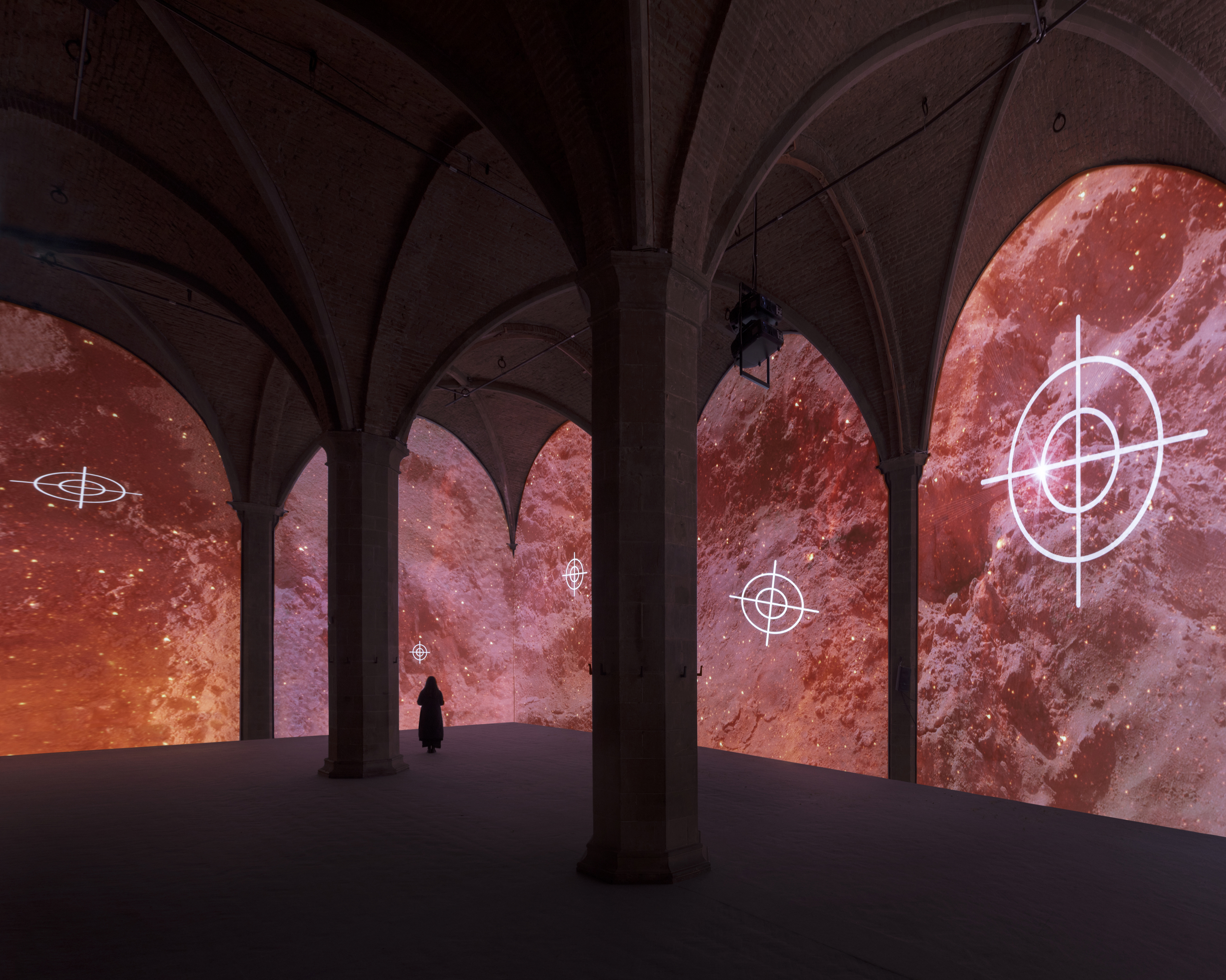
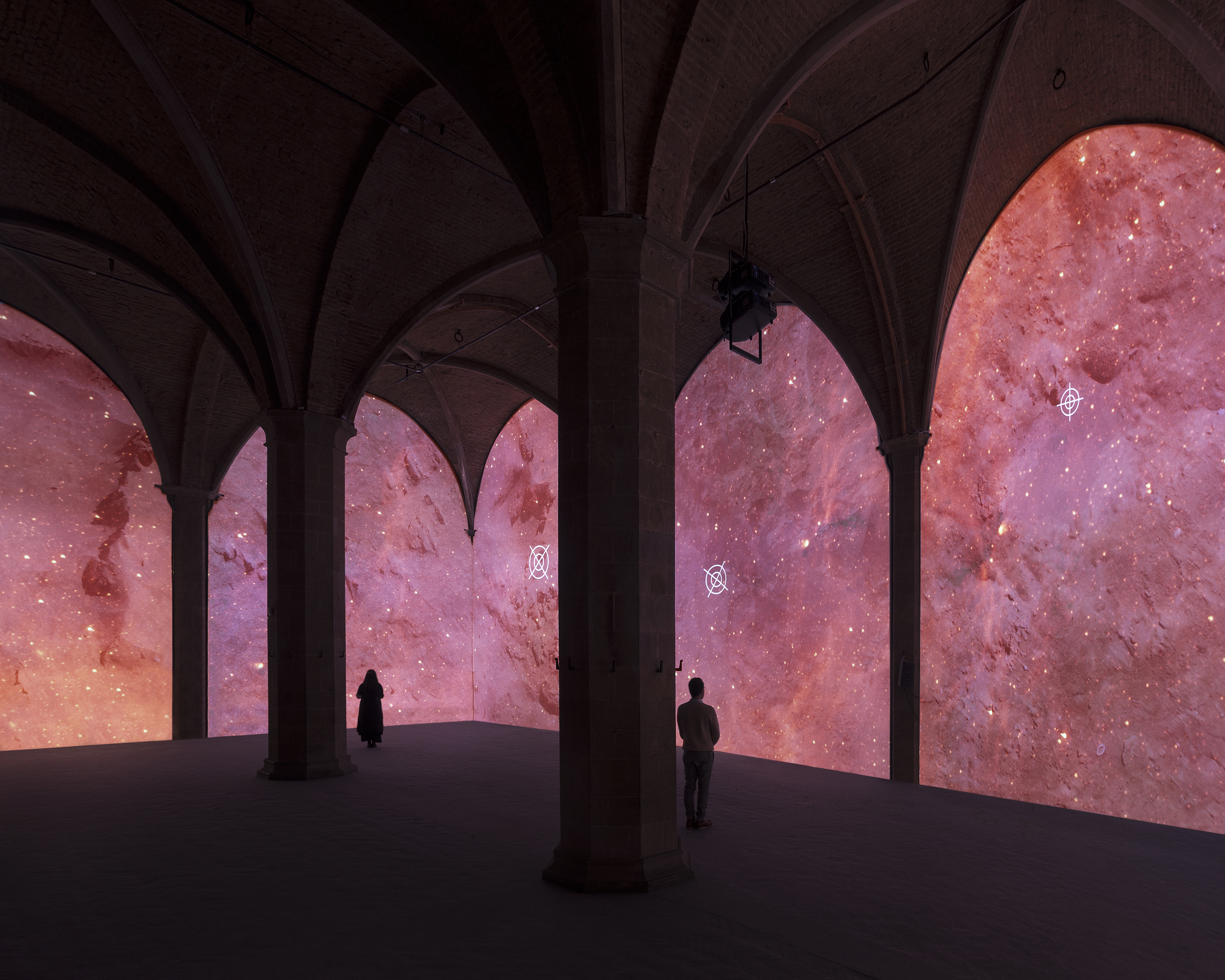
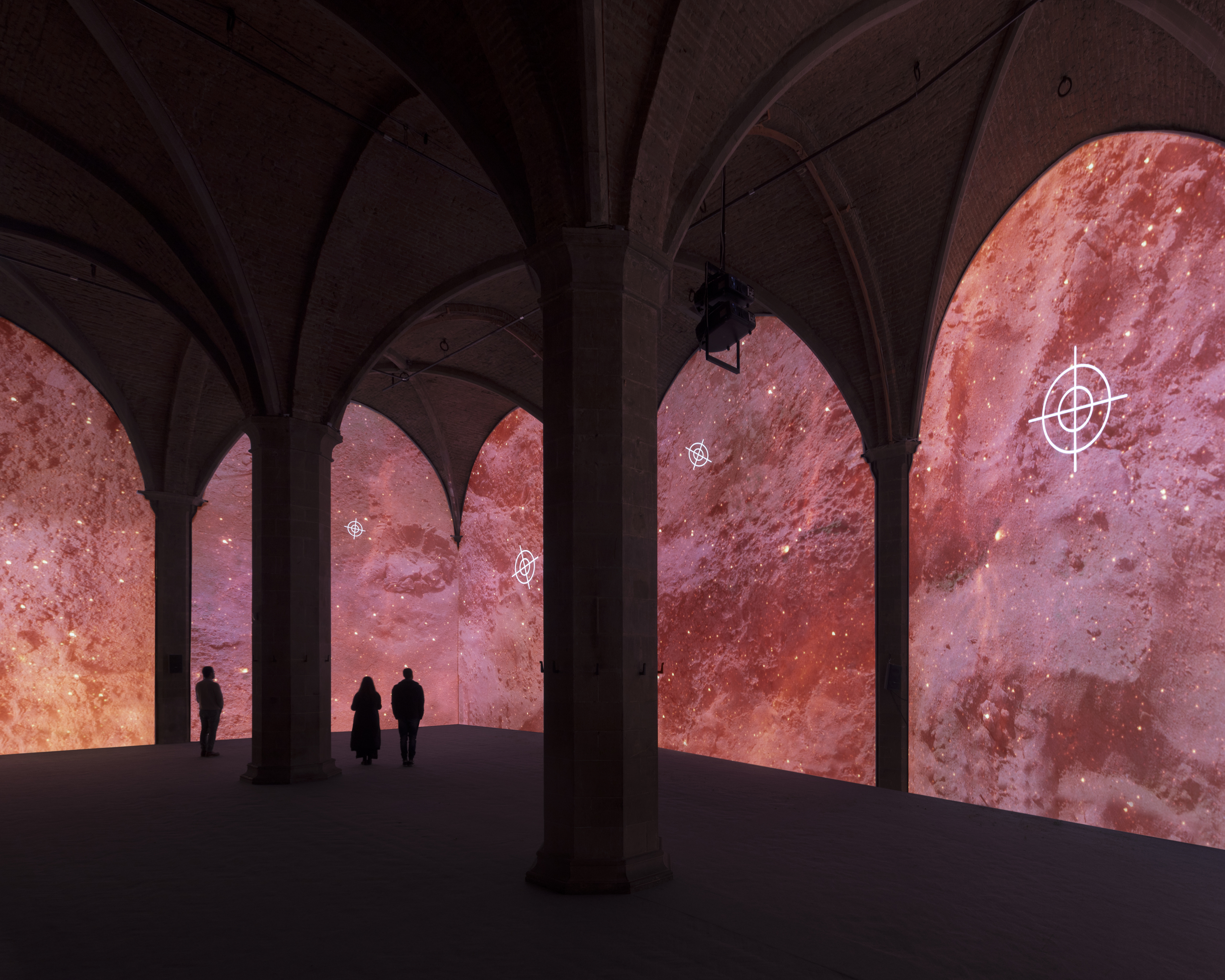
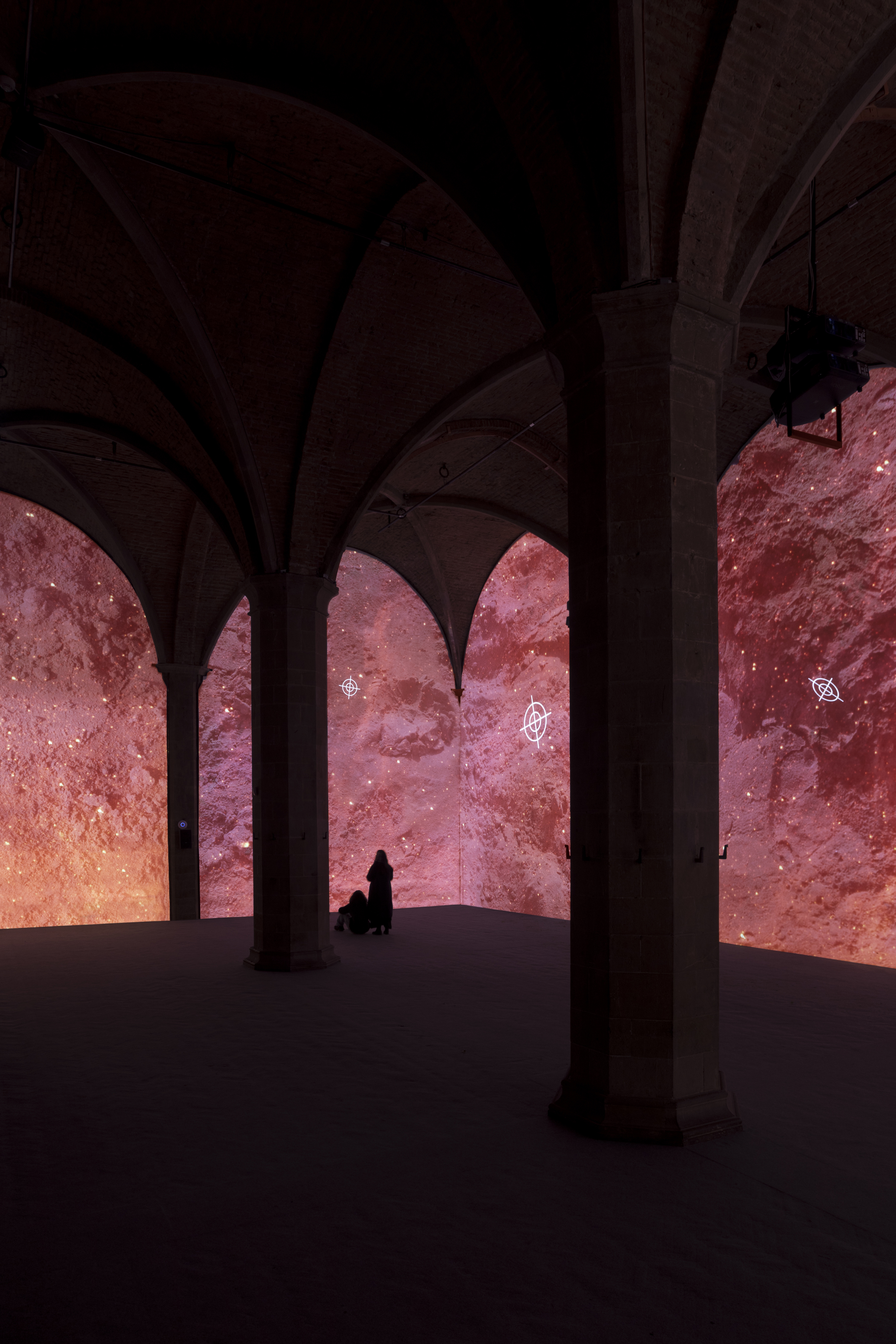
Grazia Toderi, Marco (I Mark), 2019, seven video projections, loop,
Sala delle Armi, Palazzo Vecchio, Florence, photo Nicola Gnesi