Giulio Paolini: in two acts
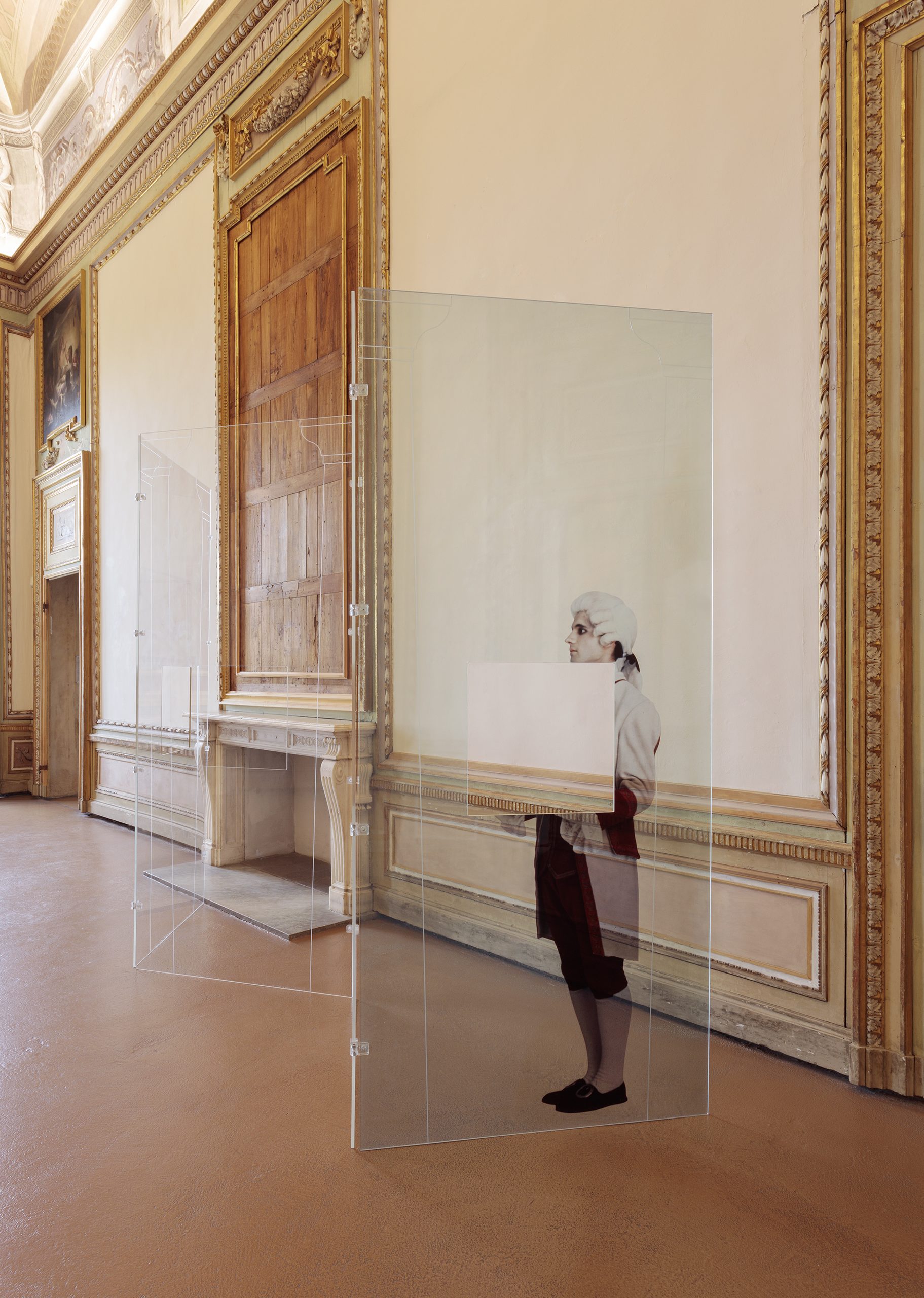
Giulio Paolini: in two acts, 2026
installation view of Act I, Castello di Rivoli Museo d’Arte Contemporanea
Photo Sebastiano Pellion di Persano
In memory of Gino Viliani
Curated by Marcella Beccaria and Andrea Viliani
Act I: from July 2026
Act II: from 29 October 2026
Second floor, Castello Building, Room 22
“Viliani Collection. Castello di Rivoli. Eight paintings, brought together here to seek an audience and visibility, bear witness to the desire once expressed by the collector Gino Viliani to see them displayed in a gallery conceived and arranged by their author. Here I am, then, at work: each painting, already endowed with its own exhibition history, lends itself here to becoming part of an ensemble, an environment expressly designed for it.”
Giulio Paolini, 2026
As part of a season devoted particularly to the leading figures of Arte Povera, Castello di Rivoli presents a project by Giulio Paolini (born in Genoa, 1940), conceived as a tribute to Gino Viliani, a passionate collector of his work.
The work of Paolini investigates the conception, manifestation and vision of the work of art. From his early explorations of the constituent elements of painting, his attention later shifted to the exhibition act itself, to the idea of the artwork as a catalogue of possibilities, and to the author as a figure from whom the work of art is autonomous.
Drawing inspiration from theatre, this project has unfolded in two acts. For the first act, which has been on view since the summer, Paolini selected, reinterpreted and installed elements from two of his own works: Contemplator enim, 1992, and In esilio, 2012–14, respectively curtains in transparent plexiglass engraved with valets dressed in eighteenth-century attire, and a cubic metal structure.
From October 2026, in the second act, following the situation of anticipation staged in the first, the two installations become devices that accommodate a group of works once owned by Gino Viliani. Paolini thus transforms the museum gallery into a narrative mechanism that evokes a theatrical piece in two acts: in the first, the elements that announce and foreshadow the performance take centre stage, while in the second, the works that are the protagonists of the mise-en-scène are revealed.
The eight works from the Viliani Collection, pledged as a gift to Castello and to GAM in Turin, span the period from 1962 to 1972, the decade in which Paolini laid the foundations for his entire practice, placing him among the first artists to work in the field of Conceptual Art before opening onto the lines of inquiry of the emerging Arte Povera. The group includes works that were unprecedented and radical for their time, such as Senza titolo, 1962, a modular pattern of monochrome crepe-paper squares; Un’offerta speciale, 1963, with a painted reproduction of the solar system on the front and a photograph and the inscription that gives the work its title on the back; M. Tullio Cicerone, 1963, a perforated wooden panel that reveals the wall behind it, with a photograph of the Latin author on the back; Senza titolo, 1964, two plywood panels, one suspended at the centre of the other. The group of works in the Viliani Collection also includes Senza titolo (dalla serie dei “Disegni”), 1964, a drawing sheet with a white canvas, exhibited here to the public for the first time; Io (frammento di una lettera), 1969, in which the pronoun “I”, isolated from a typewritten letter, acquires an independence of its own and an impersonal dimension; Una visita alla casa di Raffaello a Urbino, 1969, paper on canvas with the phrase that gives the work its title handwritten on it. And La Doublure (esemplare “La trascrizione infinita”), which reproduces the image of the canvas itself in perspective, with a row of nails aligned along the lower edge.
“Paolini thus transforms the gallery,” state the curators Beccaria and Viliani, “into an exhibition and narrative mechanism in which to bring together, as if on a single stage, different places, people, and roles: the artist’s studio, the domestic interior, the museum gallery, as well as the author, the collector, the curator, and the public— including a father and a son.”
“It is a great honor,” declare Francesco Manacorda, Director of the Castello di Rivoli, and Chiara Bertola, Director of the GAM – Galleria d’Arte Moderna in Turin, “to be able to welcome such an important collection of works by Giulio Paolini, which testifies to the fact that Gino Viliani was a visionary collector capable of making uncompromising choices. This collection represents a piece of the city’s history, not least because it chronicles the profound and significant relationship of dialogue and support that Viliani maintained with our institutions.”
Bio
Giulio Paolini was born in Genoa on 5 November 1940 and lives in Turin. Since he first participated in a group exhibition in 1961 and since his first solo show in 1964, he has held countless exhibitions at galleries and museums worldwide. The major retrospectives were organized by the Stedelijk Museum in Amsterdam (1980), the Nouveau Musée in Villeurbanne (1984), the Staatsgalerie in Stuttgart (1986), the Galleria Nazionale d’Arte Moderna in Rome (1988), the Neue Galerie am Landesmuseum Joanneum in Graz (1998), and the Fondazione Prada in Milan (2003). The most recent anthological exhibitions were held at the Whitechapel Gallery in London (2014), Fondazione Carriero in Milan (2018), and Castello di Rivoli Museo d’Arte Contemporanea in Rivoli, Turin (2020).
He has taken part in a number of Arte Povera exhibitions, and on several occasions has shown his work at Documenta in Kassel (1972, 1977, 1982, 1992), and at the Venice Biennale (1970, 1976, 1978, 1980, 1984, 1986, 1993, 1995, 1997, 2013). His work is present in renowned public and private collections in Italy and worldwide.
In 2022 he was awarded the Praemium Imperiale for Painting, the most important acknowledgement in the field of art.
Paolini’s artistic research has long been coupled with written statements and reflections collected in artist’s books: from Idem, with a foreword by Italo Calvino (Turin: Einaudi, 1975), to Quattro passi. Nel museo senza muse (Turin: Einaudi, 2006), L’autore che credeva di esistere (Milan: Johan & Levi, 2012), and Eccomi. Qui dove sono (Turin: Fondazione Giulio e Anna Paolini 2025). He has also designed sets and costumes for the theatre, notably projects devised with Carlo Quartucci in the 1980s, and the sets for two Wagner operas, directed by Federico Tiezzi (2005, 2007).
Gino (Luigino) Viliani was born in Tronzano Vercellese in 1935 and died in Casale Monferrato in 2022. Collecting, which was to become a lifelong commitment, grew neither out of formal study nor from a deliberate decision, but from a chance encounter while he was waiting in Piazza San Carlo in Turin for the coach that would take him back to the Monferrato hills, where he worked as an insurance agent. Intrigued by a gold plaque bearing the name of Galleria Christian Stein, he stepped inside and returned many times, as he would to many other galleries. He acquired his first work only several years later, having recognised the need to embark on a process of self-education first. Collecting thus became, as he himself put it, his ‘school’. While Arte Povera formed the axis around which his collecting developed, it was Giulio Paolini whose work became the focus of his close, patient study — a pursuit he shared with his children, Francesca and Andrea — and with whom his collection is most closely identified. At the opening of a solo exhibition in 2003, curated by Germano Celant and bringing together works made between 1960 and 1972, to which Viliani had lent works, Paolini met the collector in person for the first time and told him that, over the years, he had become the ‘collector of my most challenging works’. These works are now the subject of a gallery display arranged by Paolini himself at Castello di Rivoli, the museum that, alongside GAM in Turin, Gino Viliani visited regularly throughout his life, bringing its rigour and its ethical and aesthetic outlook into the private space of his home. A home whose windows were often kept half-closed to protect the works and to continue questioning them.